
How to Write With AI Without Sounding Like AI

By M. Zaid Imran | ToolsWorldAI
TL;DR
- Give AI your own notes before asking for a draft.
- Edit the facts and meaning before polishing the tone.
- Use a writing sample to guide voice; judge the result yourself.
You ask AI for a blog introduction. It gives you three tidy paragraphs, perfect grammar, and a sentence about how something is “transforming the way we work.” You read it back and think: I would never say that. so, i can tell you how to write with ai without sounding AI.
The draft sounds finished, but your point of view is missing.
Before you generate a draft, write down what you want the reader to understand. Add the facts and examples you can support. Give those notes to AI, then check whether its draft actually makes your point.
In this guide, I’ll show you how to write with AI without sounding like AI, using a process you can apply to blog posts, tutorials, and emails. You’ll get reusable prompts and an example that shows exactly what changes between a generic draft and a useful paragraph.
How to make AI writing sound human
To make AI writing sound human, start with your own ideas, give the model a specific audience and purpose, and revise its output for accuracy, detail, and voice. Read it aloud before publishing. Adding slang or deliberate mistakes won’t fix a paragraph that has nothing useful to say.
Follow this sequence:
- Write a short brief in your own words.
- Ask AI to draft one section from that brief.
- Check every claim and remove invented details.
- Replace vague advice with an example or clear action.
- Read the paragraph aloud and fix anything you wouldn’t naturally say.
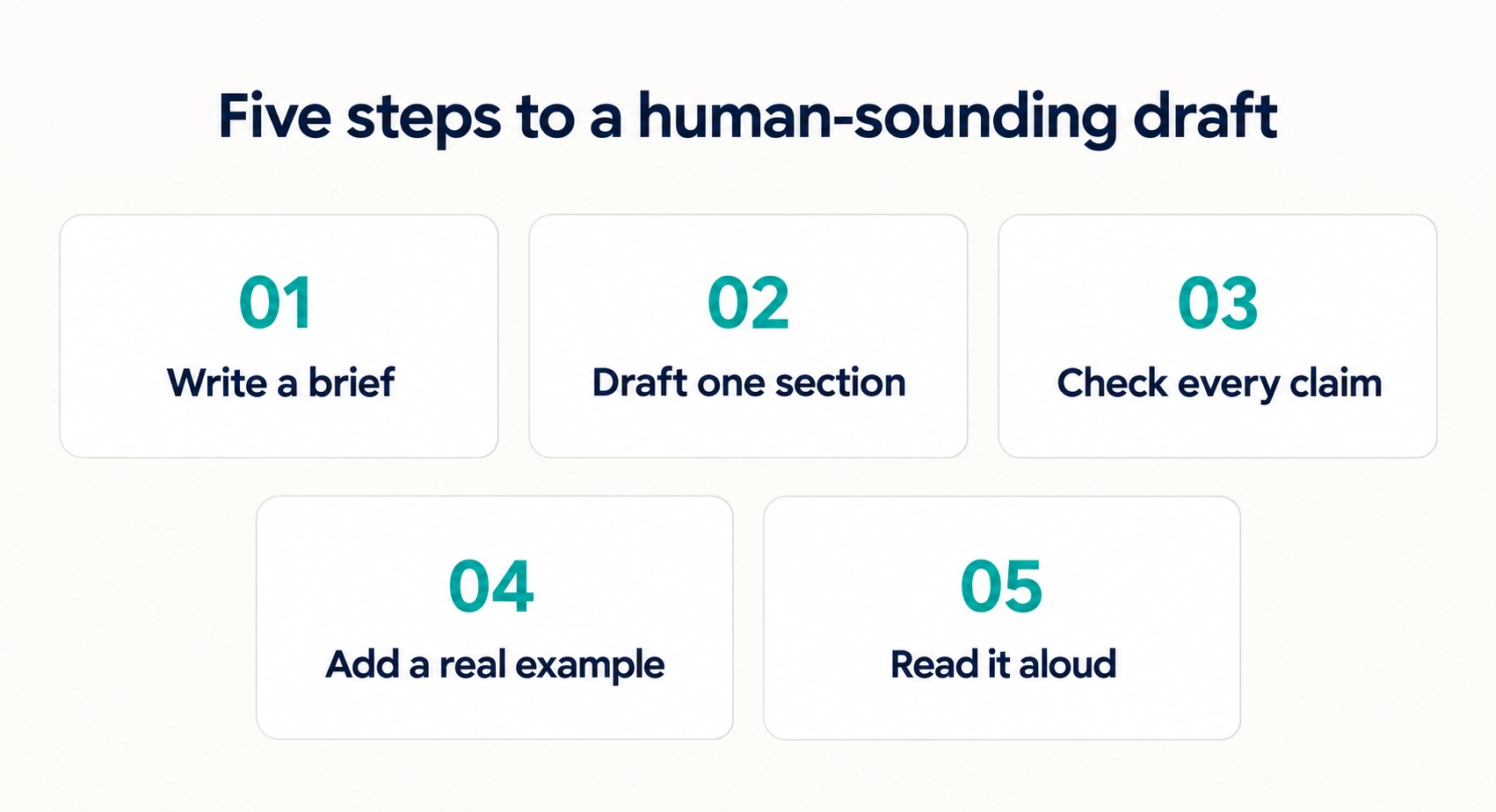
How to make AI content sound more natural before you draft
Imagine you’re writing for a freelance marketer choosing an AI writing tool. “Write an engaging introduction about AI tools” gives the model very little direction.
Give it these notes instead:
- Reader: a freelance marketer who writes client emails and weekly blog posts.
- Problem: drafts sound polished but could belong to any business.
- Main point: the quality of the input matters before sentence-level editing begins.
- Example: a client email needs a clear request and deadline.
- Boundary: don’t invent time savings, customer stories, or product features.
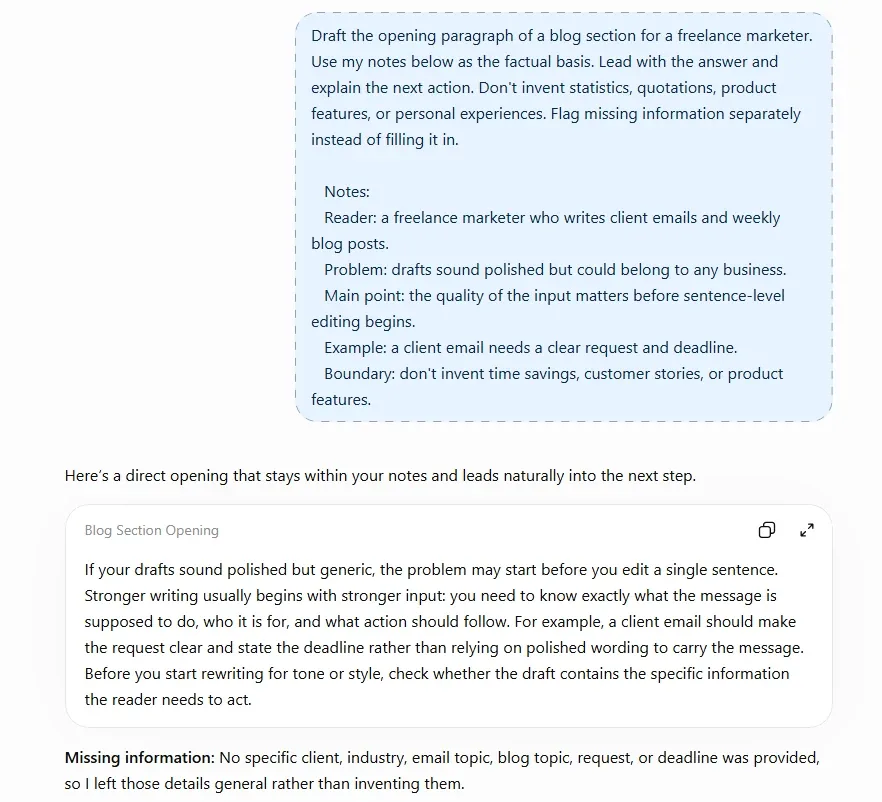
How to make ChatGPT sound less robotic
“Make it conversational” is a starting instruction, but it leaves plenty open to interpretation. Conversational for a software tutorial is different from conversational for a message to a friend.
Specify the relationship: “Explain this to a capable beginner who wants to finish the task today.” Then describe the behavior you want: answer directly, explain unfamiliar terms, and use one relevant example.
If you’re asking “why does my AI writing sound fake?”, inspect what the draft actually says. A draft feels fake when its confidence exceeds its substance. It says a tool will “revolutionize your workflow,” yet never explains which task it helps with or where it falls short.
How to make AI-written emails sound human
Consider this email:
Before: “I hope this email finds you well. I am reaching out to kindly request your valuable feedback on the attached proposal at your earliest convenience.”
After: “Hi Maya, could you review the attached proposal by Thursday at 2 p.m. ET? I need your approval on the budget before I send it to the client. Thanks, Alex.”
Example note: The email and client-update examples are fictional teaching examples.
The revision supplies information the first version lacks: what needs reviewing, when it’s due, and why the reply matters. Only add those details if they’re true.
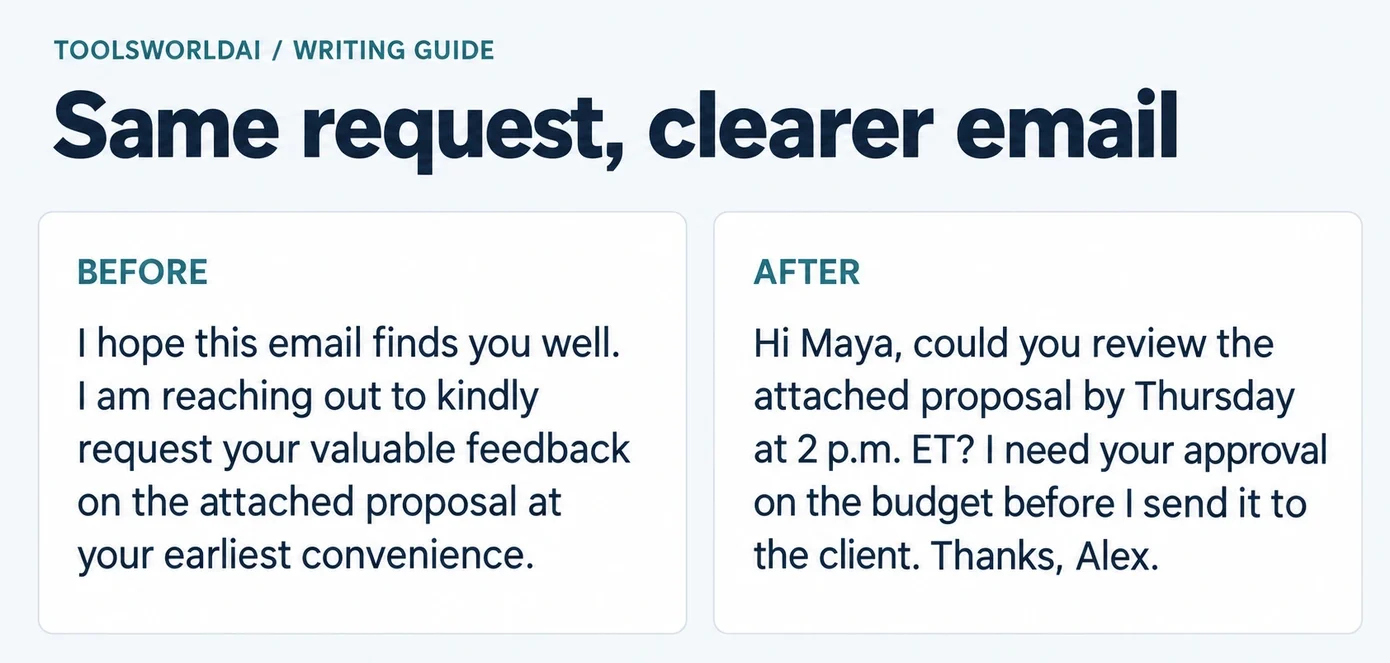
For emails, check the request before the tone. Can the recipient tell what to do next without sending a follow-up question?
How to edit AI-generated content
Edit in four passes. Check the facts first; a graceful sentence is no help if it’s wrong. Then deal with vague advice, repetition, and the sound of the writing.
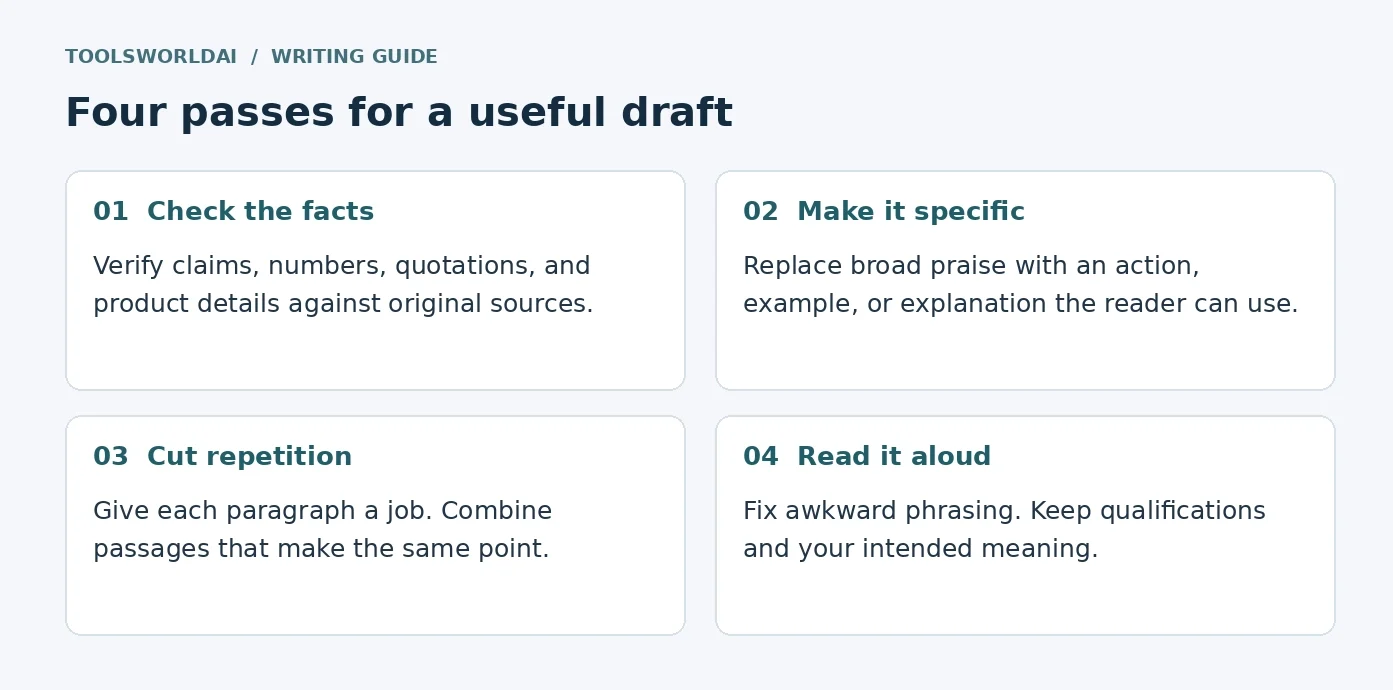
An actual edit from this ToolsWorldAI guide
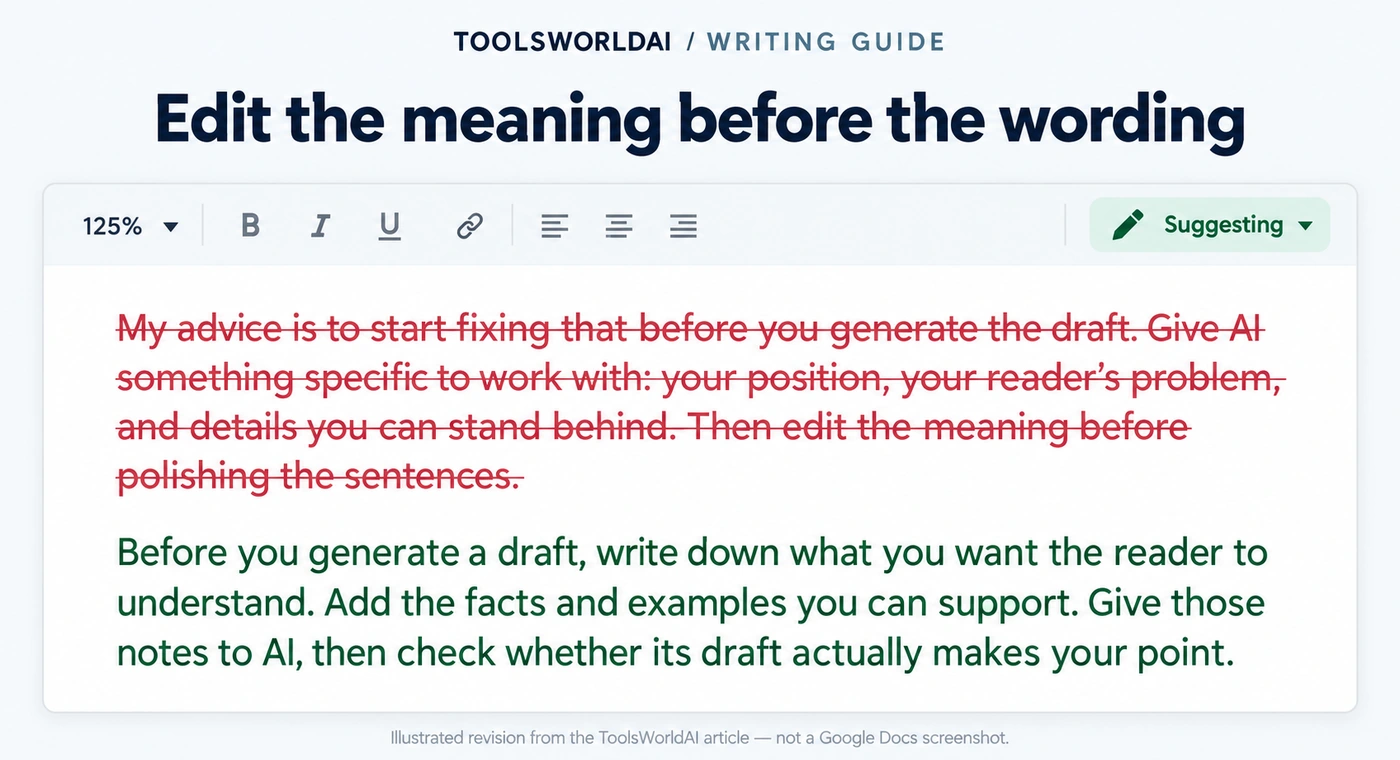
The first draft of this guide had its own problem: it spent too much time announcing the advice. Here’s a paragraph from that draft, followed by the version now in the introduction.
Before: My advice is to start fixing that before you generate the draft. Give AI something specific to work with: your position, your reader’s problem, and details you can stand behind. Then edit the meaning before polishing the sentences.
After: Before you generate a draft, write down what you want the reader to understand. Add the facts and examples you can support. Give those notes to AI, then check whether its draft actually makes your point.
The revision removes “My advice is” and replaces “start fixing that” with an action the reader can follow. It also puts evidence before drafting. The instruction arrives sooner.
The first draft also interrupted its introduction with a disclaimer about the examples. That note now sits under the email example, where it explains the example without stopping the opening. This documents the current revision.
Pass 1: Check the meaning and evidence
Underline each claim that needs support. Product prices, plan limits, statistics, quotations, and statements about Google policies all need checking against the original source.
If a draft says a tool “saves five hours a week,” look for evidence that supports that exact claim. Without it, remove the number. Changing “five hours” to “countless hours” leaves the same problem.
Preserve qualifications during editing. “May help” and “will solve” mean different things.
Pass 2: How to stop AI from sounding generic
Here’s a fictional paragraph about writing client updates:
Draft: “AI is a powerful tool that streamlines communication and enhances productivity, allowing professionals to focus on what truly matters.”
The paragraph offers praise but gives the reader nothing to try. Replace it with a task:
Edited: “Before asking AI to draft a client update, list what changed, what’s blocked, and what you need the client to approve. Those notes give the draft a clear purpose. Check the names, dates, and promises before sending it.”
Notice that the edit changes the information, not just the vocabulary. There’s now a task, a method, and a final check.
Pass 3: How to make AI writing less repetitive
Write a short label beside each paragraph: problem, example, instruction, evidence, or limitation. If three paragraphs make the same point, combine them or cut the weakest ones.
Then look for repeated openings such as “Additionally,” “Moreover,” and “It’s important to.” Sometimes the relationship between paragraphs is already obvious, so the transition can go.
Pass 4: Read for voice and rhythm
Read the draft aloud at a normal pace. Where do you run out of breath? Which phrase makes you pause because it sounds unlike you?
Shorten overloaded sentences, but let some longer sentences remain where the explanation needs them. Turning every thought into a three-word statement can sound just as manufactured as an overly formal paragraph.
How to add your own voice to AI writing
Your voice includes the judgments you make: what deserves attention, which trade-offs matter, and how directly you explain a problem. Adjectives such as “friendly” or “professional” capture only a small part of that.
How to train ChatGPT to write in my style
In a normal writing conversation, you’re guiding the model with examples rather than training its underlying model. Start with two or three short samples you wrote yourself, ideally in the same format as the new piece.
Ask it to describe observable features: sentence length, formality, use of examples, and how you explain uncertainty. Correct that description before requesting a draft.
Turn the corrected version into a reusable voice brief. For example:
Use direct explanations and ordinary words. State a recommendation and explain the reason. Use contractions where they fit. Keep technical terms when they’re necessary, then explain them. Avoid forced jokes, hype, and claims of personal experience I haven’t supplied.
Save the brief yourself and provide it when needed. Don’t assume every new conversation will retain the same context.
How to write AI text so it sounds like me
Try writing your own version of the most important paragraph first. Ask AI to revise surrounding sections to fit that sample while preserving the facts.
If you’re wondering how to use AI for writing without losing your voice, keep ownership of the central argument and final recommendation. Let the model suggest alternatives; decide which ones deserve your name.
Words and phrases that make writing sound like AI
No word proves that AI wrote a sentence. Use this table to spot empty language. Don’t delete a useful word just because someone put it on an “AI words” list.
| Phrase to review | What to check | Possible revision |
|---|---|---|
| “In today’s fast-paced digital world” | Does the opening reach the reader’s problem? | Start with the actual task or frustration. |
| “Unlock the full potential” | What can the reader actually do? | Name the result or action. |
| “Seamlessly integrate” | Are there setup steps or limitations? | Describe the connection and requirements. |
| “Game-changing” | Is the praise supported? | Explain the specific advantage. |
| “It’s important to note” | Can the sentence begin with the point? | Delete the lead-in if nothing is lost. |
| “Delve into” | Does simpler wording fit? | Use “explain,” “look at,” or a precise verb. |
Two AI writing mistakes to avoid: replacing every formal word with slang and adding typos to seem authentic. Both can make a useful explanation harder to read.
Another mistake is inventing a personal story to make the draft feel credible. “When I tested this with my clients” is a factual claim. Use it only if that test happened and you can describe it accurately.
I’d skip AI humanizer tools for this process. A rewrite aimed at lowering a detector score doesn’t answer the editorial questions that matter: Is the claim true? Does the paragraph help? Edit against those questions directly.
And leave the deliberate typos out. Your reader shouldn’t need to forgive bad spelling to believe a person was involved.
Prompts to make AI write like a human
A useful prompt defines the task and editing boundaries. “Write like a human” alone doesn’t tell the model which information to use or what your readers need.
A prompt for drafting from your notes
Draft a [section/email] for [specific reader]. Their immediate problem is [problem]. Use my notes below as the factual basis. Lead with the answer and explain the next action. Use natural American English. Don’t invent statistics, quotations, product features, or personal experiences. Flag missing information separately instead of filling it in. Notes: [paste notes].
Prompt for matching your voice
Read these samples of my writing. Describe five observable style features and show a brief example of each. Wait for my corrections. Then revise the draft using the approved style brief. Preserve the meaning, qualifications, and phrases I mark “keep.” Samples: [paste]. Draft: [paste].
A prompt for editing without erasing meaning
Review this draft for vague claims, repeated ideas, inflated language, and awkward sentences. For each issue, show the original wording, explain the problem, and propose a revision. Preserve factual meaning and uncertainty. List claims that need verification; don’t call them verified unless you checked an original source. Draft: [paste].
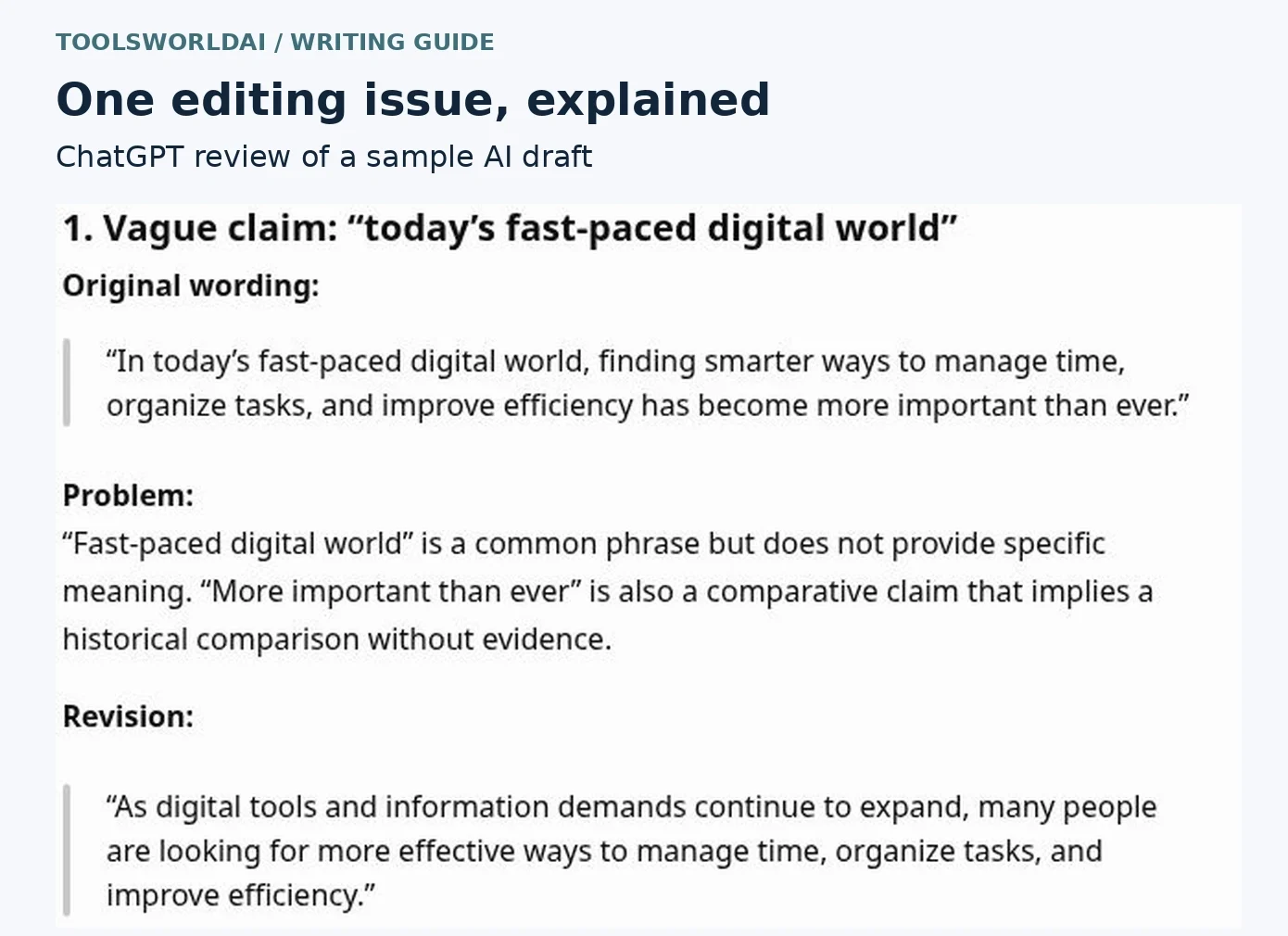
Review the suggestions individually. An edit that reads more smoothly can still change your point.
Can Google tell if content is written by AI?
Google’s public guidance doesn’t establish that it can reliably identify the origin of every passage. It does explain what publishers should focus on: useful content and compliance with its spam policies. Appropriate AI use isn’t automatically against its guidelines.
Google’s scaled content abuse policy addresses producing large amounts of content primarily to manipulate rankings without helping users, regardless of how it is created.
How to humanize AI content for SEO
For an AI tools blog, give readers something they can evaluate: a worked example, a documented test, a screenshot from an actual task, or a clear explanation of a tool’s limitation.
Use the reader’s question in a descriptive heading and answer it directly. Add related terms where they explain the topic. Don’t force an awkward keyword into every section.
Google also advises checking AI-generated material for accuracy and giving readers appropriate context about how content was created. A detector score doesn’t replace those checks, and conversational wording alone doesn’t guarantee rankings.
Is it okay to use AI to write blog posts?
Yes. Google’s guidance allows appropriate use of AI, and a useful article can be developed with AI assistance. The publisher still needs to take responsibility for its accuracy and value.
For ToolsWorldAI, my standard is straightforward: product recommendations need evidence. A claim that one tool is “best for beginners” needs an explanation: easier setup, clearer instructions, or fewer steps for the task being discussed.
Before publishing, ask whether the article answers something the reader couldn’t resolve from a feature list. Keep your author information accurate, explain testing methods when you report tests, and never imply hands-on use based solely on a vendor’s description.
Frequently asked questions
Why does AI writing sound so robotic?
Broad prompts often produce broad answers. Repeated sentence patterns, excessive transitions, and vague praise can make a draft feel mechanical. Supply specific notes, define the reader’s problem, and edit the information before adjusting the tone.
How can you tell if something was written by AI, and do AI detectors actually work?
You can’t establish authorship from polished grammar or a few familiar phrases alone. Detectors can make mistakes. OpenAI withdrew its own classifier in July 2023 because of low accuracy; that historical example isn’t a benchmark for every current detector. [4] Don’t treat a score as proof of authorship or a quality rating.
What words does ChatGPT overuse?
Phrases worth reviewing include “delve into,” “unlock the potential,” and “game-changing.” This is an editing watchlist, not a measured ranking of word frequency. Keep any word that fits the meaning and remove language that contributes only padding or hype.
Will Google penalize AI-written content?
AI use alone isn’t a reason for a penalty under Google’s published guidance. Content that violates its spam policies can be affected regardless of whether people or AI produced it. Focus on original value, accuracy, and the reader’s needs.
How do I make AI write like me?
Provide samples you wrote, ask the model to describe their style, and correct its interpretation. Use that description alongside your notes for the new piece. Review the final draft yourself, especially opinions and claims of personal experience.
Try the editing prompt today
Choose 200 words from your current draft and run the editing prompt above today. Check the claims, keep the useful changes, and read the result aloud before publishing.
For the publishing side, read Google’s guidance on AI-assisted content. Use it to review the finished page after you’ve made the writing clear.