Best AI Writing Tools in 2026: 8 Picks I’d Shortlist for Blogs, SEO, Books & Marketing
AI writing tools have become much better at producing words. Unfortunately, that has made choosing one harder, not easier.
ChatGPT can help me research and structure an article. Claude can take the same draft in a slightly different direction. Jasper focuses heavily on marketing and brand consistency. Sudowrite and Novelcrafter make far more sense for a novelist. Grammarly is useful when the writing already exists and needs polishing.
So when someone asks me, “What is the best AI writing tool?”, my first response is usually another question:
What are you actually trying to write?
A blogger, novelist, ecommerce owner and marketing team should not automatically buy the same software.
For this guide, I compared the tools I would realistically shortlist in 2026 based on writing quality, usefulness for long-form work, editing control, free access, pricing, specialist features and how much manual cleanup I would expect after generation.
I deliberately kept the list shorter than many “best AI writer” roundups. I would rather explain eight useful choices properly than give you 30 names and leave you with the same decision you had before opening the article.
If you want the short version, start here.
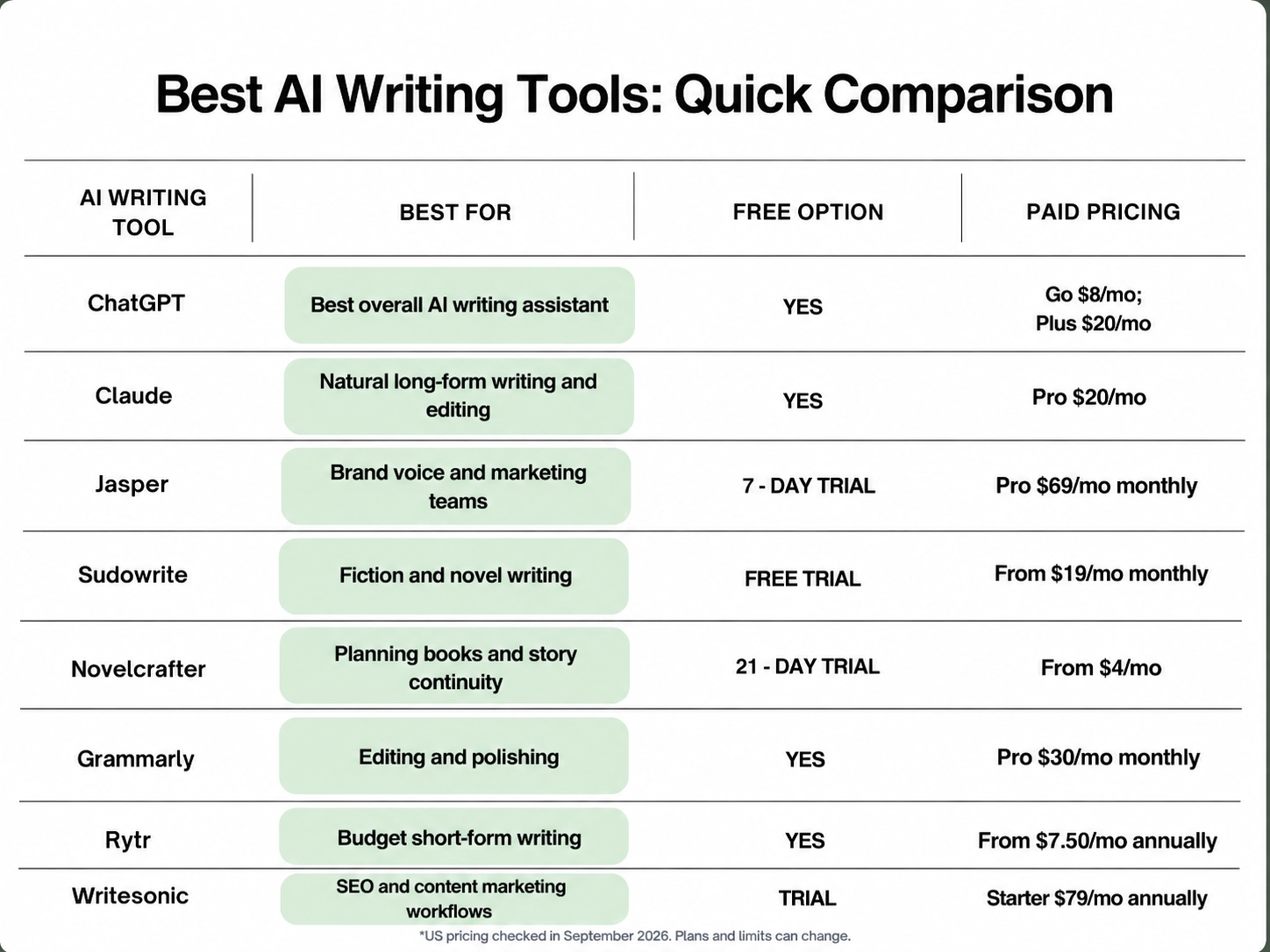
| AI writing tool | Best for | Free option | Paid pricing to know* |
| ChatGPT | Best overall AI writing assistant | Yes | Go $8/mo; Plus $20/mo |
| Claude | Natural long-form writing and editing | Yes | Pro $20/mo |
| Jasper | Brand voice and marketing teams | 7-day trial | Pro $69/mo monthly |
| Sudowrite | Fiction and novel writing | Free trial | From $19/mo monthly |
| Novelcrafter | Planning books and story continuity | 21-day trial | From $4/mo |
| Grammarly | Editing and polishing | Yes | Pro $30/mo monthly |
| Rytr | Budget short-form writing | Yes | From $7.50/mo annually |
| Writesonic | SEO and content marketing workflows | Trial | Starter $79/mo annually |
*US pricing checked in September 2026. Plans and limits can change.
My quick picks: ChatGPT is the easiest all-round recommendation. Claude is one of my first choices for long-form rewriting. Jasper makes more sense for teams than solo bloggers. Sudowrite is the strongest specialist here for fiction, while Novelcrafter stands out for managing a complicated book project.
How I Ranked the Best AI Writing Tools in 2026

I do not rank an AI writer by how many words it can generate in 30 seconds.
That stopped being impressive a long time ago.
Almost every serious AI writing product can create a blog introduction, product description or email. The useful differences appear after the first draft.
Here are the factors I care about most.
Writing quality
I want writing that gives me something useful to edit, not 1,500 words of perfectly grammatical filler.
That means looking at clarity, repetition, tone, sentence variety and whether the output actually follows the brief.
Control over the result
Good AI writing requires iteration.
I want to be able to say:
- Keep my examples but simplify the explanation.
- Make this less promotional.
- Write for a US small-business audience.
- Remove repetitive phrases.
- Do not change these statistics.
- Match the tone of these three sample paragraphs.
For me, that kind of control is more valuable than a library containing hundreds of rigid templates.
Long-form usefulness
Short-form copy is relatively easy for modern AI.
A harder test is maintaining context and structure across a detailed article, report, chapter or book.
That is why long-context chat tools and specialist book-writing platforms deserve separate consideration.
Editing workflow
Generation is only half the job.
The best artificial intelligence writing tools should also help improve existing text through rewriting, restructuring, shortening, tone adjustment or feedback.
Price
A $70-per-month writing tool needs to solve a bigger problem than a free chatbot.
I therefore look at value based on the user. A marketing department may save money with Jasper. A new blogger might simply be adding another unnecessary subscription.
Specialisation
This is the part many comparison articles miss.
The best AI for writing is often the tool designed around your specific workflow rather than the one with the longest feature list.
The 8 Best AI Writing Tools I’d Consider in 2026
-
ChatGPT — Best AI Writing Tool Overall
If someone wants one AI tool that can handle most writing-related tasks, ChatGPT is still where I would start.
Its advantage is flexibility.
I can use the same conversation to develop an article idea, research questions, analyze source material, create an outline, rewrite weak sections, generate alternatives and critique the finished draft.
It does not lock me into a specific “blog generator” workflow.
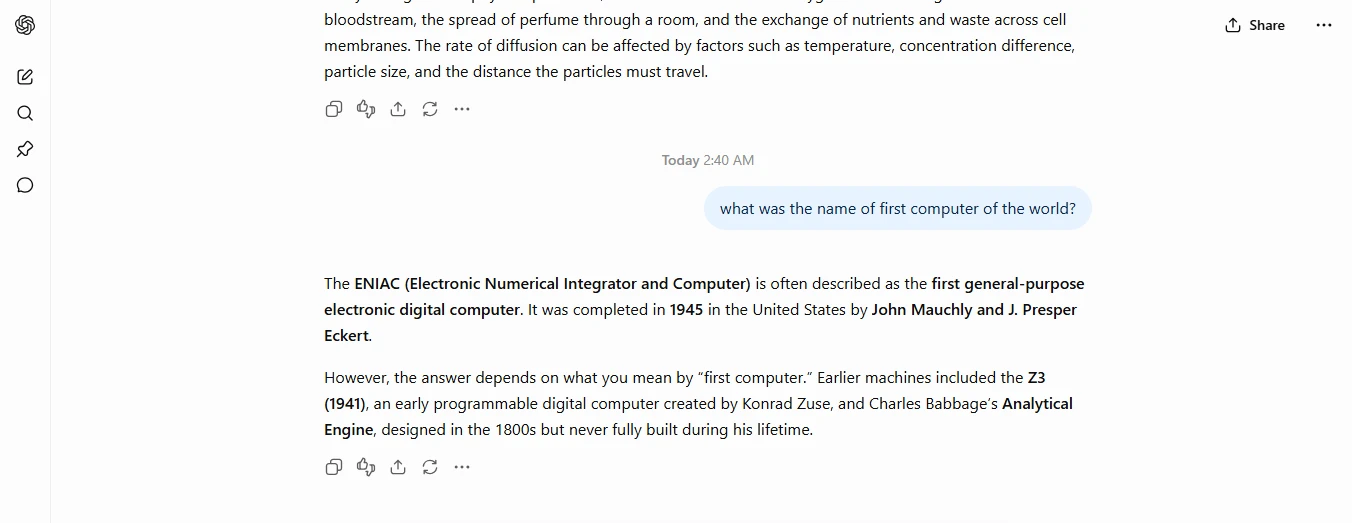
That matters because my writing rarely happens in a straight line.
I might start with:
Give me five angles for an article about AI website builders aimed at US freelancers.
Then move to:
Which of these angles has the clearest commercial search intent?
Then:
Build an outline, but leave room for my own testing notes.
And finally:
Review this introduction and tell me where it sounds generic.
That back-and-forth is what makes ChatGPT more useful to me than a basic one-click article generator.
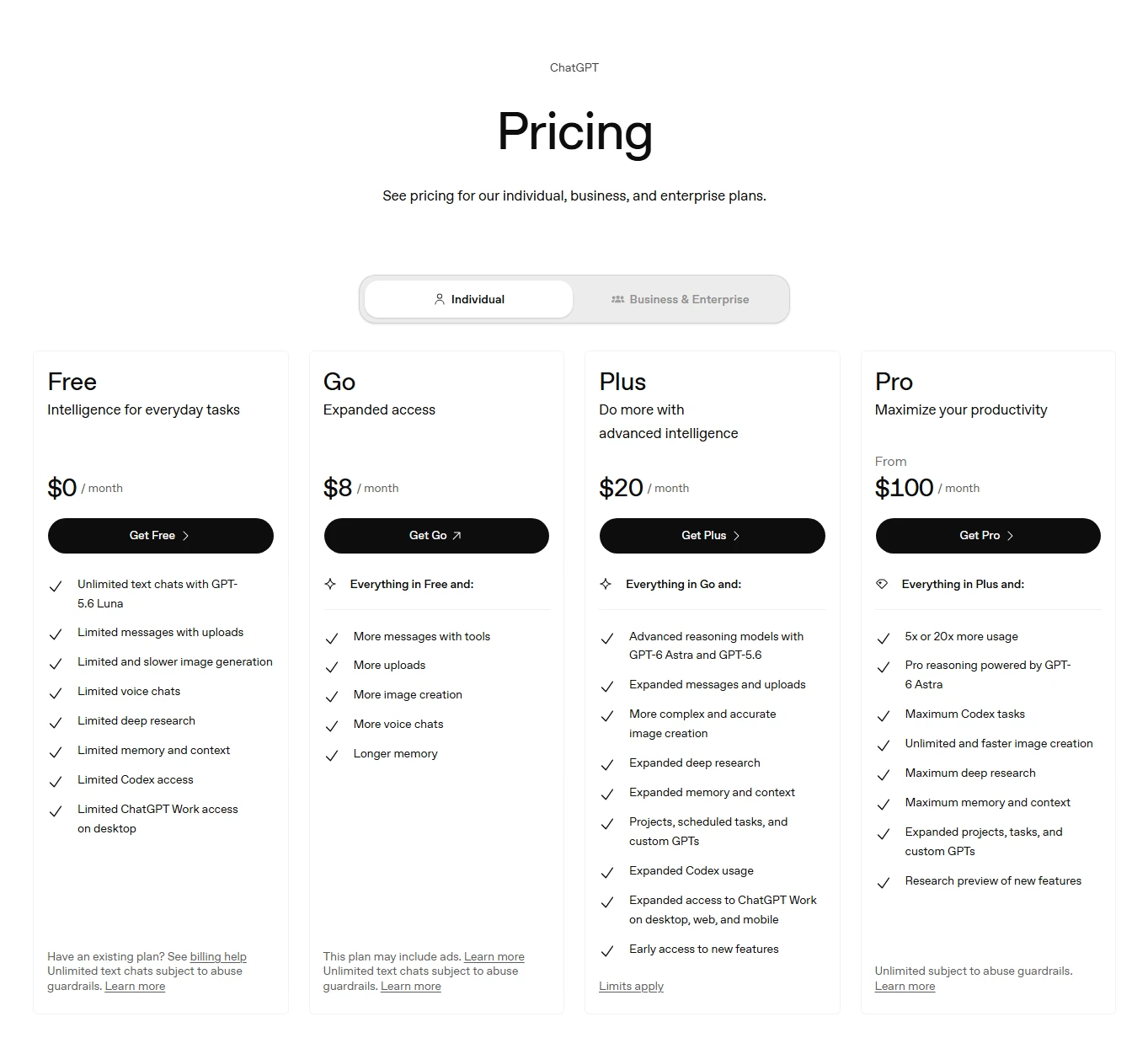
ChatGPT also has meaningful free access. OpenAI currently offers a Free plan, ChatGPT Go at $8 per month in the US, Plus at $20 per month, and Pro at $100 or $200 per month. Plus provides higher limits and broader model and tool access than Free.
Where I would use ChatGPT
- Blog research and outlines
- Long-form drafting
- Rewriting
- Email copy
- Product descriptions
- Social content
- FAQs
- Headline brainstorming
- Content repurposing
- Analyzing uploaded research
- Finding gaps in an existing draft
What I do not like
The first draft can still sound too neat.
If I ask for “a professional 2,000-word SEO article,” I often get exactly the kind of structure everyone else can generate: predictable introduction, evenly sized sections, generic benefits and an overly tidy conclusion.
That is why I see ChatGPT as a writing workspace, not an automatic publishing button.
Best for: Bloggers, freelancers, marketers, students and small businesses.
Skip it if: You specifically need a purpose-built novel-writing environment or enterprise brand management.
My rating: Best overall
-
Claude — Best AI for Long-Form Writing and Editing
Claude is the tool I would compare most closely with ChatGPT for serious writing.
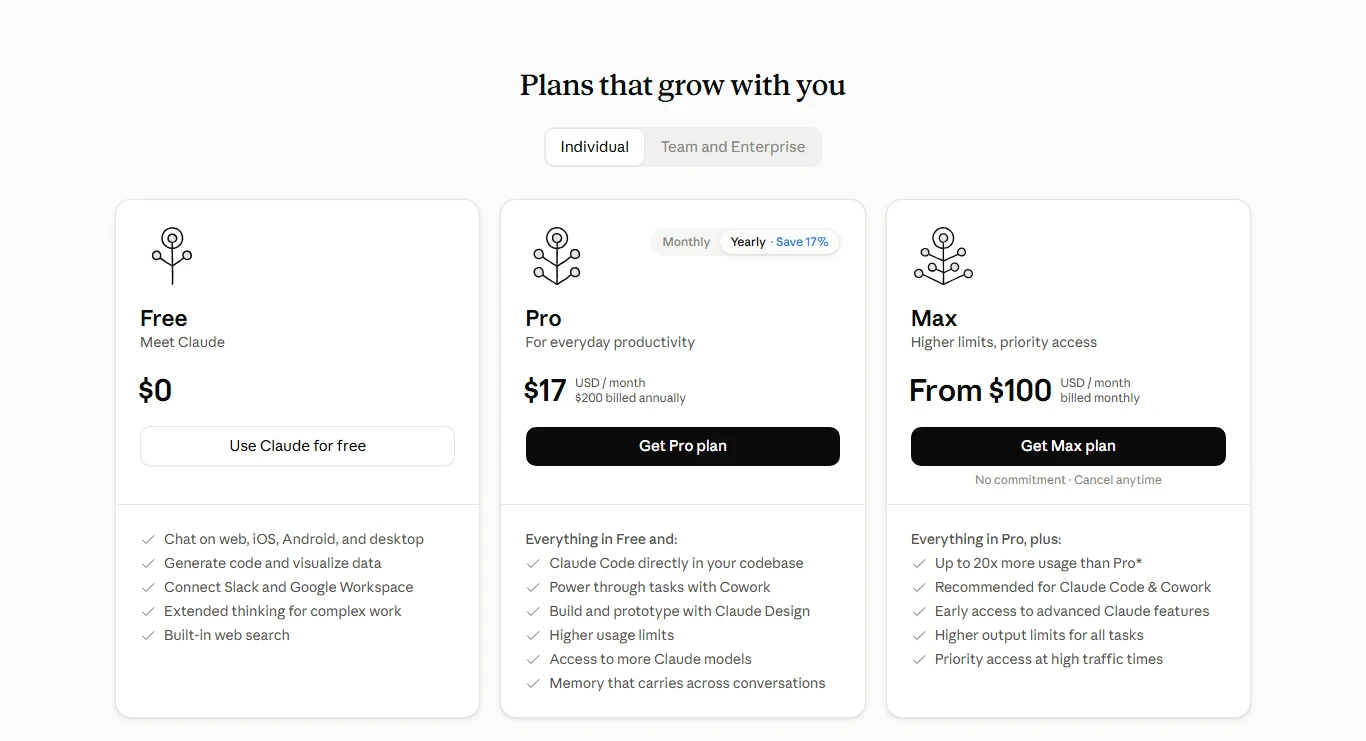
Anthropic positions Claude around writing, editing, document analysis, projects and research. Its Free plan costs $0, while Claude Pro costs $20 per month in the US or roughly $17 per month when paid annually.
Where Claude becomes particularly interesting is long-form work.
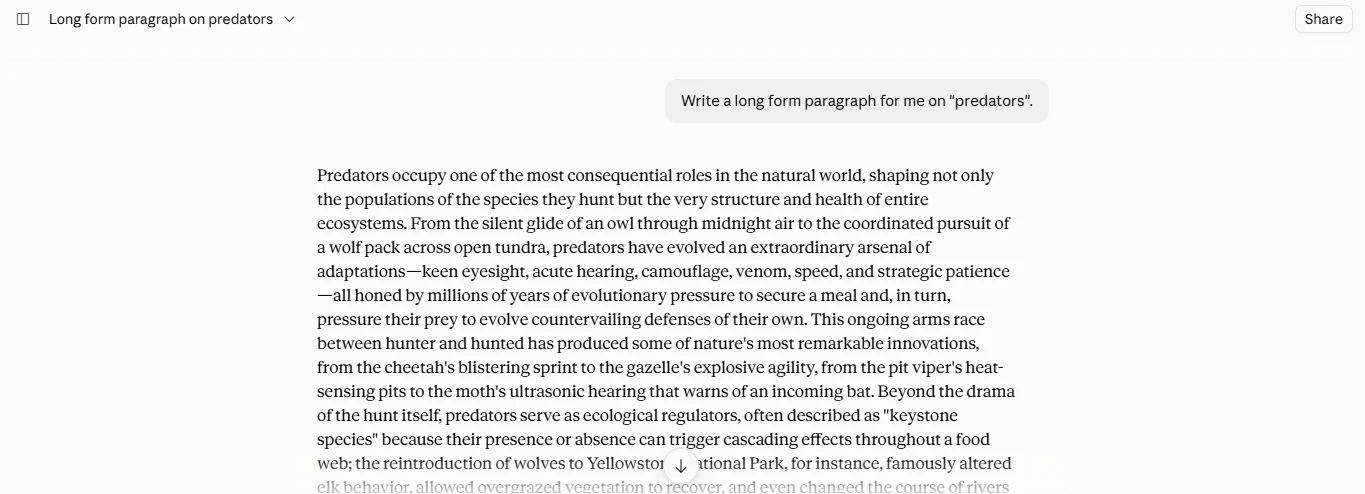
If I already have a substantial article, report or chapter and want the AI to understand the whole thing before making edits, Claude belongs on my shortlist.
Claude vs ChatGPT for writing
I would </span>not declare one universally better.
>
I would use Claude when my priority is:
- Long-form rewriting
- Working through large documents
- Preserving the tone of an existing piece
- Reviewing structure
- Developing extended prose
I lean towards ChatGPT when I want:
- Broad research workflows
- File analysis
- Image-related work
- Flexible tools beyond writing
- One general AI workspace
The smartest approach is surprisingly simple.
Take 600 words of your real writing and paste the exact same brief into both.
Ask:
Improve clarity and flow without making this sound more formal. Do not remove my examples or change my opinion.
Then compare the edits.
That tells you far more than reading another “Claude scored 9.4/10” table.
Best for: Bloggers, editors, researchers and long-form writers.
Skip it if: You mainly need templated marketing campaigns and brand workflow management.
My rating: Best for long-form editing
-
Jasper — Best AI Writing Tool for Consistent Brand Voice
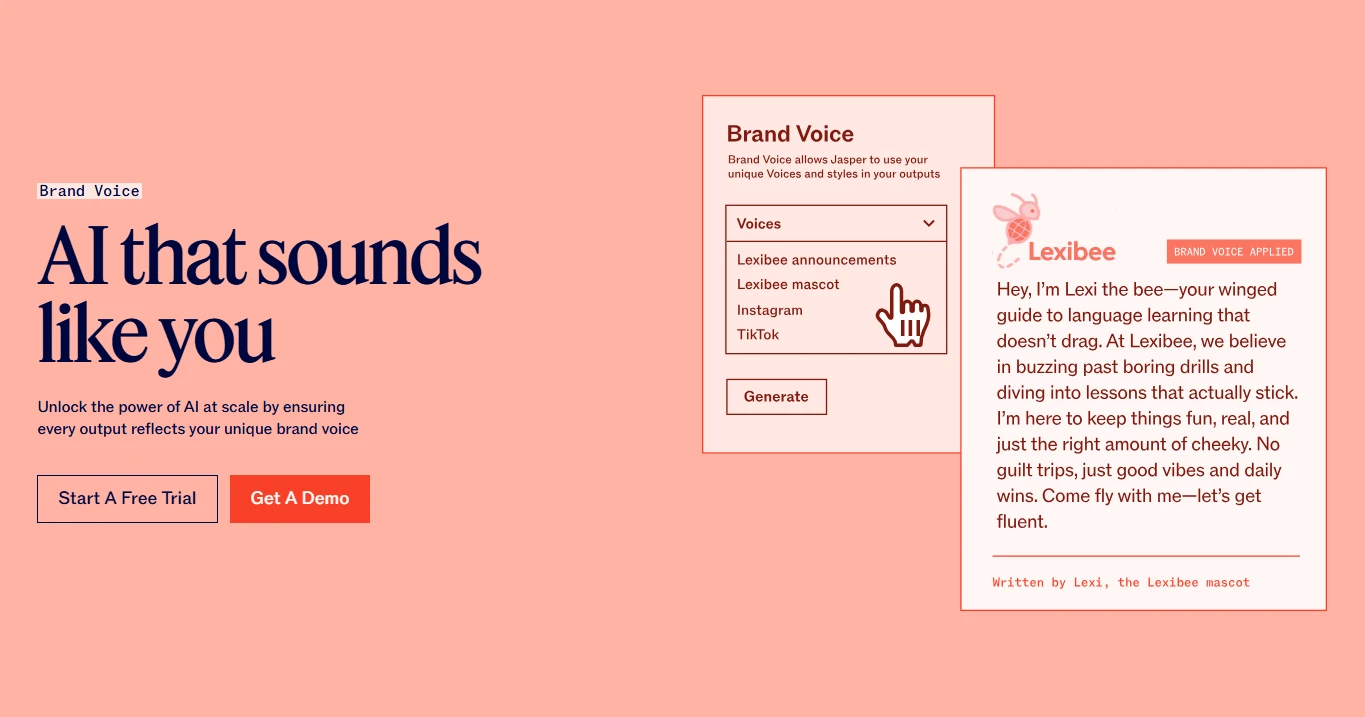
Jasper is harder for me to recommend to a casual blogger because it solves a more specific business problem.
That problem is content consistency at scale.
Jasper’s current Pro plan includes brand voices, knowledge assets, audience controls and marketing-focused AI workflows. Pro costs $69 per month when billed monthly or $59 per month with annual billing, and Jasper offers a seven-day trial.
That is considerably more than ChatGPT Plus or Claude Pro.
So why pay it?
Because a marketing team may not just need “good writing.”
Imagine a US SaaS company where six people are producing:
- Landing pages
- Paid ads
- Email campaigns
- Social posts
- Product announcements
- Case studies
The challenge is no longer generating text.
The challenge is making all that text sound as though it came from the same company.
That is where Jasper’s emphasis on Brand Voice, audiences, knowledge and campaign workflows starts to make sense.
Claude vs ChatGPT vs Jasper
Here is how I simplify the decision:
ChatGPT: Best general-purpose option.
Claude: Best fit when long-form writing and editing dominate the workflow.
Jasper: Best fit when brand consistency and marketing operations dominate the workflow.
For a solo blogger publishing four articles per month, Jasper would probably be more tool than I need.
For an agency handling multiple clients, I would take it much more seriously.
Best for: Agencies, marketing departments and teams producing branded content at scale.
Skip it if: You mainly need an inexpensive personal writing assistant.
My rating: Best for brand voice
-
Sudowrite — Best AI Tool for Fiction Writing
Most AI writing platforms were built around marketing.
Sudowrite was built around authors.
That difference matters.
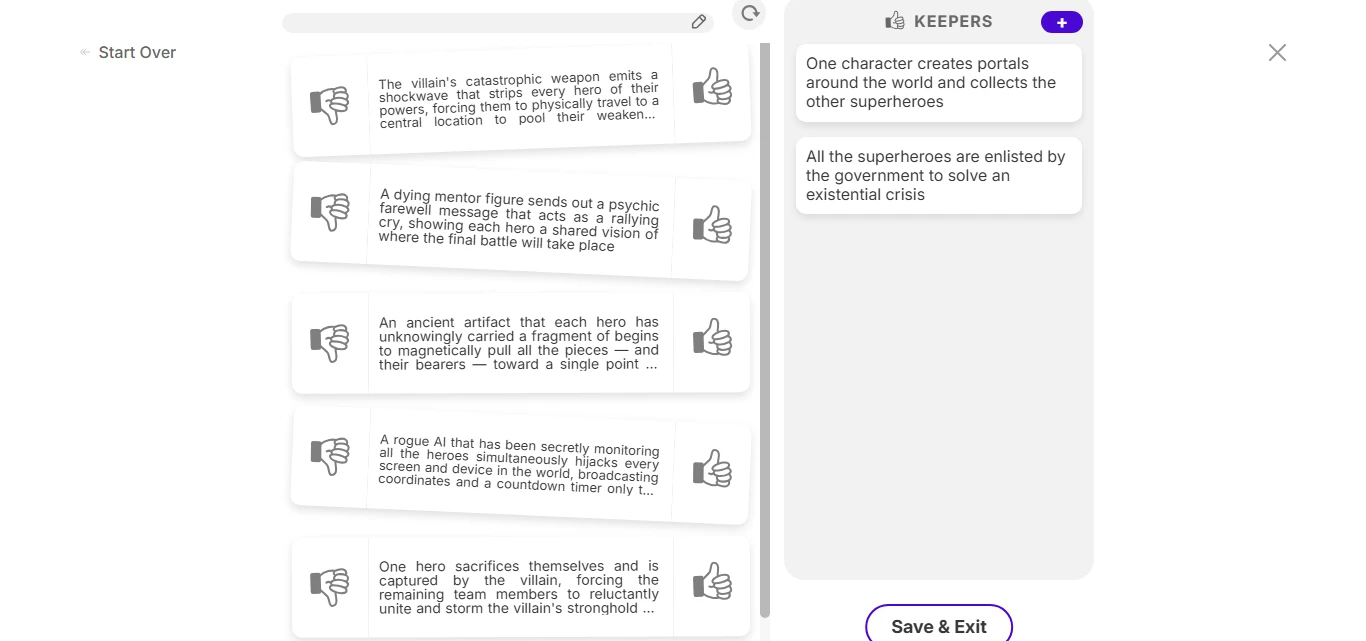
Its workflow focuses on things fiction writers actually struggle with: brainstorming, developing scenes, continuing a draft, descriptions, character work and feedback.
Sudowrite currently offers Hobby & Student, Professional and Max plans. Monthly prices start at $19, while annual billing reduces the entry plan to $10 per month. Its free trial does not require a credit card.
This is why I would not automatically call ChatGPT the best AI tool for writing a book.
ChatGPT can absolutely help write fiction.
But a dedicated writing environment is designed around a different problem.
A novelist needs to remember:
- Character motivations
- Relationships
- Timeline
- Locations
- Scene goals
- Point of view
- Plot threads
- Pacing
- Previous chapters
Generating another paragraph is the easy part.
Managing the story is harder.
Sudowrite is the option I would look at when the main goal is actually producing fiction rather than occasionally asking an AI for story ideas.
Best for: Novelists, fiction writers and screenwriters.
Skip it if: Your work is mainly blogging, SEO or business copy.
My rating: Best for fiction writing
-
Novelcrafter — Best AI Book Writing Tool for Story Planning
Novelcrafter competes with Sudowrite, but I would not treat them as identical products.
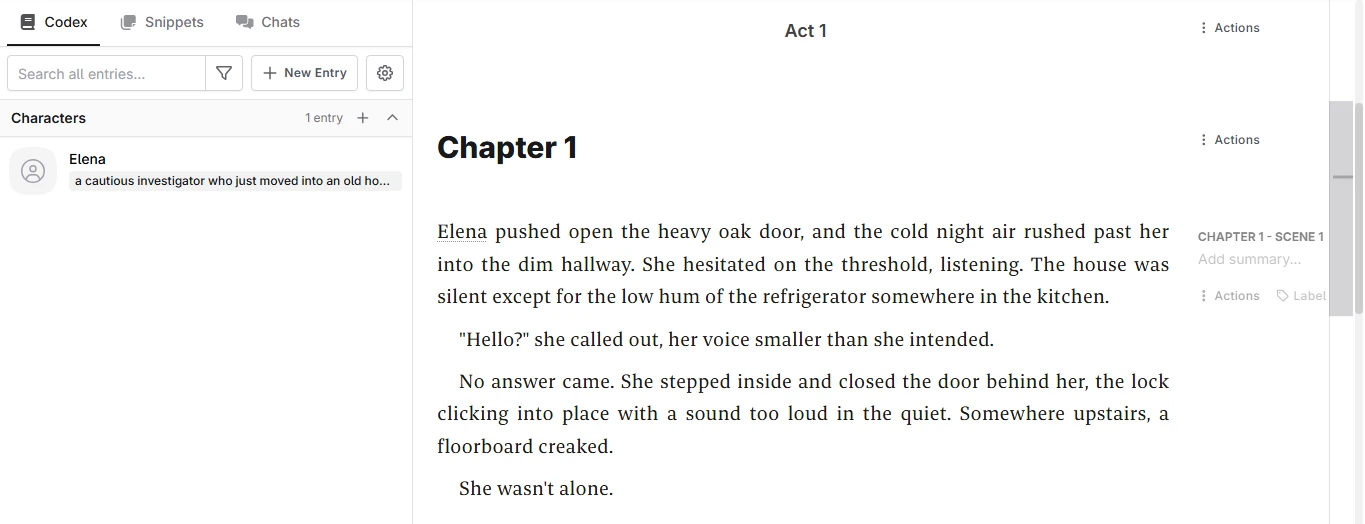
Novelcrafter’s appeal is its writing system and story organization.
One of its standout features is the Codex, which helps writers maintain information about characters, locations and other elements of a story world. Novelcrafter currently offers a 21-day free trial with no credit card required, and paid plans start at $4 per month.
Sudowrite vs Novelcrafter
My simplified recommendation is:
Choose Sudowrite if you primarily want creative AI help while generating and expanding prose.
Choose Novelcrafter if story planning, organization and maintaining context across a long project are higher priorities.
Novelcrafter is also unusually affordable for someone who wants to experiment with a specialist book-writing workflow.
If you are writing an 80,000-word fantasy novel with a dozen important characters and multiple locations, that structure may be much more valuable than another general chatbot tab.
Best for: Novelists working on complex books or series.
Skip it if: You write mostly short-form commercial content.
My rating: Best for book planning
-
Grammarly — Best for Editing Writing You Already Have
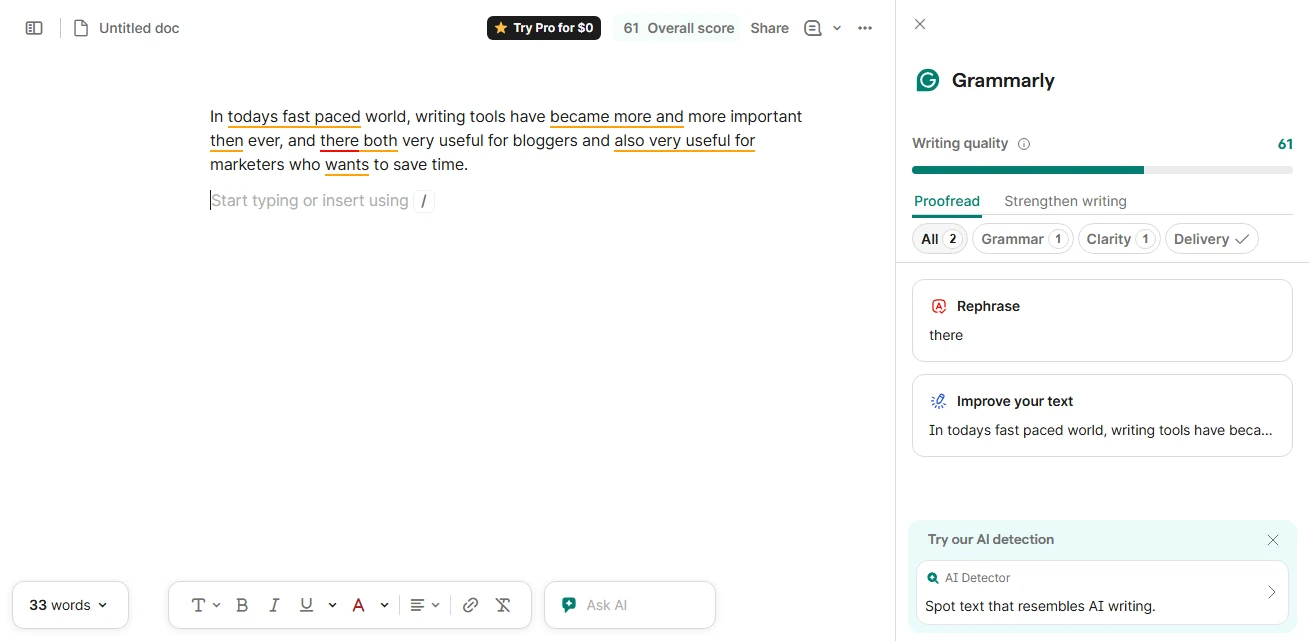
I put Grammarly in a different category from ChatGPT.
Use ChatGPT or Claude to develop content.
I would use Grammarly when content already exists and needs another editing pass.
The Free plan currently includes core writing corrections, tone information and 100 generative AI prompts. Grammarly Pro increases that to 2,000 AI prompts and adds features such as full-sentence rewrites, tone adjustment and brand-related controls. Pro costs $30 per month when billed monthly or $12 per month per member with annual billing.
Grammarly free vs paid
I would stay with Grammarly Free if I mainly want:
- Grammar checks
- Spelling corrections
- Basic clarity help
- Tone visibility
I would consider Grammarly Pro if I regularly need:
- Full sentence rewrites
- Tone adjustments
- More generative AI usage
- Brand consistency
- Frequent professional editing
One advantage Grammarly has is that it fits into the writing process rather than always forcing me into a separate chatbot conversation.
The disadvantage is obvious: if I am already paying for another strong AI assistant, I need to decide whether another subscription genuinely saves enough editing time.
Best for: Professionals, bloggers, students and teams polishing existing writing.
Skip it if: Your main requirement is generating complete drafts from scratch.
My rating: Best editing assistant
-
Rytr — Best Budget AI Writing Tool
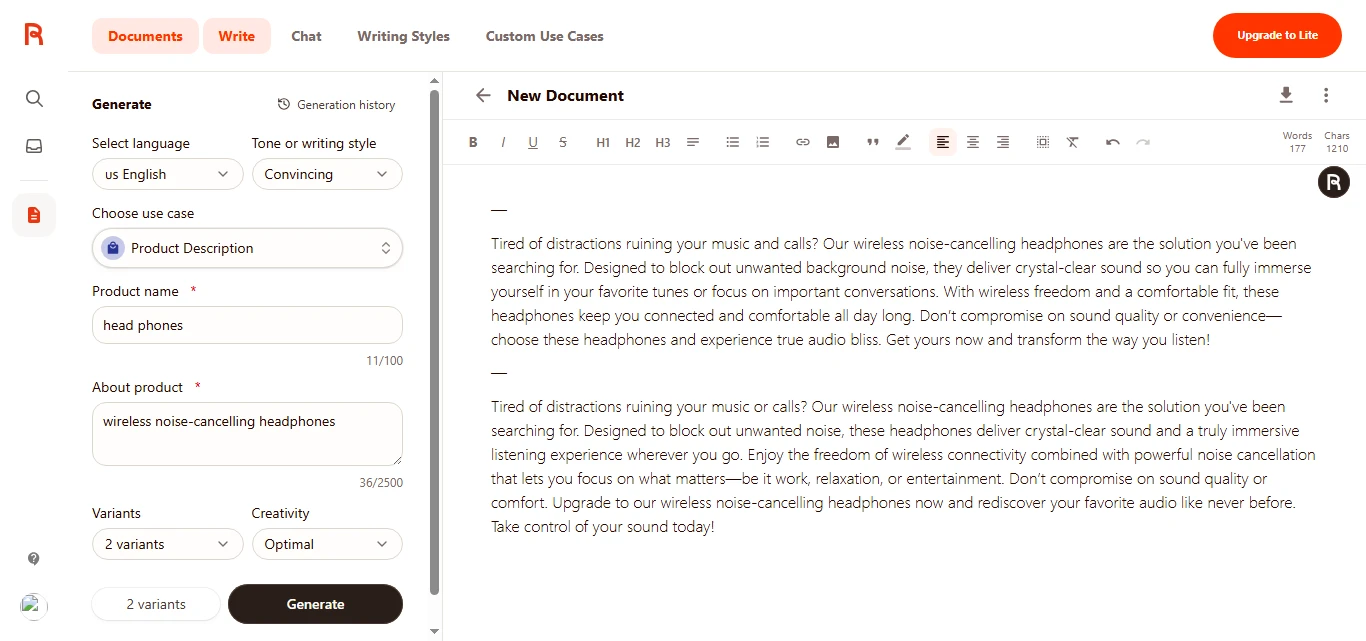
Rytr is worth including because not everybody needs another $20, $30 or $70 monthly subscription.
Its Free plan currently includes 10,000 characters per month and does not require a credit card. Its Unlimited plan starts at $7.50 per month on annual billing, while Premium is $24.16 per month on the annual option.
I see Rytr as most useful for straightforward short-form content.
Think:
- Emails
- Social captions
- Calls to action
- Meta descriptions
- Short website copy
- Product descriptions
- Ad variations
If I needed 3,000 words of research-heavy content, I would prefer the flexibility of ChatGPT or Claude.
If I owned a small online store and needed ten alternative product descriptions without paying for an expensive marketing suite, Rytr becomes more attractive.
Best AI tool for product descriptions
For a small catalog, I would start with ChatGPT or Rytr.
For a larger marketing operation where brand consistency matters, Jasper becomes more compelling.
The right choice depends on scale rather than which model can generate the fanciest paragraph.
Best for: Freelancers, startups and budget-conscious small businesses.
Skip it if: Complex research and long-form writing dominate your workload.
My rating: Best budget option
-
Writesonic — Best AI Writing Tool for SEO Content Workflows
Writesonic is no longer just another basic AI article generator.
Its current positioning combines AI content with SEO, site audits and visibility tracking across AI-powered search experiences.
The Starter plan is currently listed at $79 per month when billed annually, and includes AI articles, site audits and tracking across platforms such as ChatGPT, Gemini and Google AI Overviews.
That makes it considerably more expensive than a general AI assistant.
But it is solving a broader problem.
For an SEO team, writing the paragraph is often not the hardest part.
They also need to know:
- What topics to cover
- Where content gaps exist
- Which pages need updating
- How competitors are appearing
- Whether the website has technical/content issues
- How content performs beyond traditional blue-link search
This is where specialist AI writing tools for SEO can justify a premium.
For a new personal blog, I would not rush to spend this much.
For an agency or content-driven business where organic search directly generates leads, it is a different calculation.
Best for: SEO teams, agencies and content marketers.
Skip it if: You just need help writing a few articles each month.
My rating: Best for structured SEO workflows
Best AI Writing Tool by Use Case
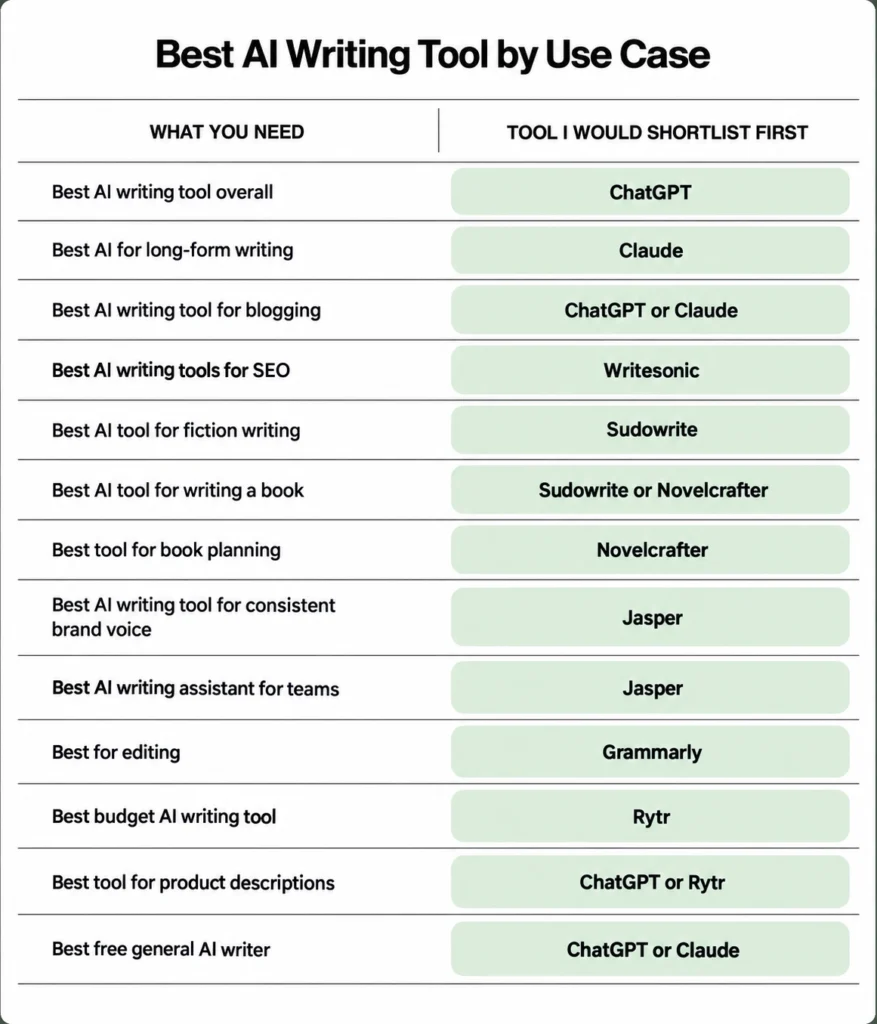
If you are still comparing tabs, here is the decision table I would use.
| What you need | Tool I would shortlist first |
| Best AI writing tool overall | ChatGPT |
| Best AI for long-form writing | Claude |
| Best AI writing tool for blogging | ChatGPT or Claude |
| Best AI writing tools for SEO | Writesonic |
| Best AI tool for fiction writing | Sudowrite |
| Best AI tool for writing a book | Sudowrite or Novelcrafter |
| Best tool for book planning | Novelcrafter |
| Best AI writing tool for consistent brand voice | Jasper |
| Best AI writing assistant for teams | Jasper |
| Best for editing | Grammarly |
| Best budget AI writing tool | Rytr |
| Best tool for product descriptions | ChatGPT or Rytr |
| Best free general AI writer | ChatGPT or Claude |
I would not buy software based on this table alone.
Use it to reduce eight choices to two. Then test those two on your real work.
Best Free AI Writing Tools: What Can You Actually Use Without Paying?
Free AI writing tools are far better in 2026 than they were a few years ago.
My shortlist would be:
ChatGPT Free
ChatGPT’s Free tier includes chat plus access to tools such as web search, file uploads and image creation, although usage limits apply.
For a beginner, this is probably the first free option I would try.
Claude Free
Claude also has a $0 plan that can write, edit, analyze text and images, and search the web.
If your priority is prose and document work, it is worth comparing directly with ChatGPT.
Grammarly Free
Grammarly Free makes sense if you already write the text yourself and mainly need correction and light AI assistance. It currently includes 100 AI prompts.
Rytr Free
Rytr offers a free-forever plan with 10,000 characters per month and explicitly says no credit card is required.
AI writing tools with no credit card
Two specialist trials also stand out:
- Sudowrite: Free trial, no credit card required.
- Novelcrafter: 21-day free trial, no credit card required.
If you are specifically searching for an AI writing tool with no credit card, I would start there rather than entering payment information for five platforms and hoping I remember to cancel.
Claude vs ChatGPT free plan
I would not overthink this comparison.
Both provide genuinely useful free access.
Use both with the same assignment until one repeatedly gives you results that require less editing.
The limitation with free plans is usually not basic writing quality. It is usage capacity and access to advanced features.
How I Make AI Writing Sound More Human
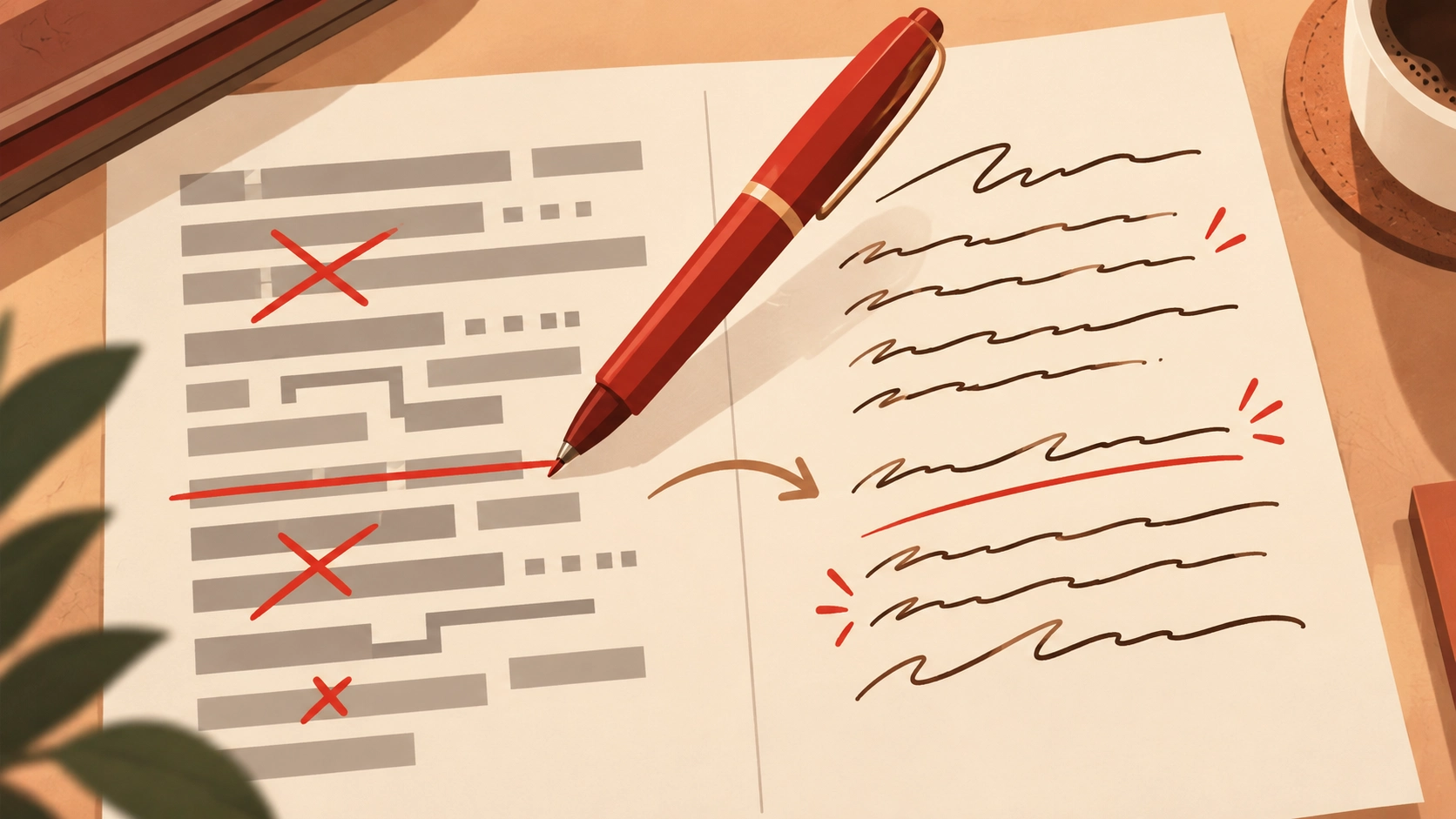
I do not believe the answer is a “humanizer” button.
The better solution is changing how AI is used in the writing process.
-
Start with your own material
Instead of:
Write an article about the best email marketing tools.
I would provide:
- The audience
- My ranking criteria
- My opinion
- Tools I liked or disliked
- Screenshots
- Pricing research
- Test results
- Specific examples
- Competitor gaps
Then I ask AI to help organize and improve that material.
That produces much more useful content because the value is coming from the source material, not from a generic prompt.
-
Stop asking for “professional” writing
“Make it professional” often pushes AI toward stiff, predictable language.
Try instructions such as:
Write this like an experienced software reviewer explaining the decision to a smart friend. Use plain English. Keep technical details where they help. Remove marketing language.
That gives the model far more direction.
-
Remove predictable AI phrases
Phrases I regularly question during editing include:
- “In today’s digital landscape”
- “It’s important to note”
- “Whether you’re a beginner or professional”
- “This is where X comes in”
- “In conclusion”
- “Game-changer”
- “Unlock the power of”
None is forbidden.
They simply become obvious when they appear repeatedly across AI-generated articles.
-
Add actual judgment
Compare these:
Jasper is a powerful AI tool with many useful marketing features.
Versus:
I would struggle to justify Jasper’s $69 monthly price for a solo blog, but its brand controls make much more sense once several people are writing for the same company.
The second sentence helps someone make a decision.
That is what a commercial comparison article needs.
-
Edit the structure, not just the sentences
AI often creates suspiciously perfect symmetry.
Real articles do not need to be that tidy.
Let an important section run longer.
Let an obvious answer stay short.
That alone makes the article feel more natural and easier to read.
Internal link opportunity: Link to “How to make ChatGPT sound less like AI.”
Does AI Writing Hurt SEO in 2026?
No. Using AI does not automatically hurt SEO. Low-value content is the bigger risk.
Google’s current guidance says generative AI can be useful for research and structuring original content. The problem is using generative AI to create large numbers of pages without adding value, which can violate Google’s scaled content abuse policy.
This distinction matters.
Google is not telling publishers:
“Never use AI.”
Its guidance continues to emphasize useful, accurate, relevant, people-first content. Google also specifically recommends unique, non-commodity content for visibility across its newer AI search experiences.
Does Google penalize AI content?
Google does not have a blanket penalty simply because AI helped create a page.
Automation becomes a spam issue when its primary purpose is manipulating rankings, particularly through scaled, low-value content.
For an AI tools blog, I would concentrate on elements a generic generator cannot easily reproduce:
- Original screenshots
- Real test prompts
- Current pricing checks
- Before-and-after outputs
- Your own ranking methodology
- Clear negatives, not just positives
- Comparisons based on actual workflows
- Update dates
- Links to primary sources
Those are the parts that turn an AI-assisted draft into a useful review.
What about AI content detection?
I would not optimize an article around getting a particular “AI score.”
AI detectors are classification systems, not perfect authorship tests. Recent research found that detector performance becomes more difficult to interpret with hybrid and human-edited AI text, and false positives remain a concern.
For SEO, the better question is:
Does this page provide enough original value that someone would choose it over ten similar results?
That is a much healthier target than trying to satisfy an AI detector.
FAQ: Best AI Writing Tools
What is the best AI writing tool in 2026?
For most individual users, I would start with ChatGPT because it combines writing, research, rewriting and document work in one flexible platform. Claude is my closest alternative for long-form writing, while Jasper, Sudowrite and Writesonic make more sense for specialized workflows.
What is the best free AI writing tool?
ChatGPT and Claude are the strongest general-purpose free options on this list. Grammarly is better for editing existing writing, while Rytr offers a free traditional AI writing plan with 10,000 characters per month.
Is Claude better than ChatGPT for writing?
Claude can be an excellent choice for long-form drafting, document work and rewriting. ChatGPT is a broader all-purpose workspace. I would test the same real draft in both rather than choosing based only on feature lists.
What is the best AI tool for writing a book?
For fiction, I would shortlist Sudowrite and Novelcrafter. Sudowrite focuses more heavily on creative generation and story development, while Novelcrafter is particularly appealing for planning, context and organizing complex story information.
Does Google penalize AI-written content?
Not simply because AI was involved. Google’s guidance focuses on value, accuracy and usefulness. Producing large amounts of unoriginal AI content primarily to manipulate rankings can violate its spam policies.

Final Verdict: Which AI Writing Tool Should You Choose?
The biggest mistake I would avoid is paying for several AI writers that all solve roughly the same problem.
Start with the job you need done.
If I wanted one flexible writing assistant, I would choose ChatGPT.
long-form prose and editing were my priority, I would put Claude next to it and compare both.
For a marketing team where maintaining a consistent brand voice matters, I would investigate Jasper.
For fiction, I would move away from general chatbots and look at Sudowrite and Novelcrafter.
If I mainly wanted to improve writing I already created, Grammarly would make more sense.
For simple writing on a small budget, I would look at Rytr.
And if SEO research, content operations and AI-search visibility are central to the business, Writesonic becomes a more serious option.
My final recommendation is to shortlist two, not eight.
Give both the same real assignment. Include your audience, tone, examples and constraints. Then ask yourself one question:
Which result would I actually be happier putting my name on after editing it?
That is usually a better way to find the best AI writing tool than counting templates, features or generated words.