Jasper AI in 2026: What It’s Actually Good For (and What It Costs Now)

Jasper AI has changed more in the last year than most tools in this space. It started as a template-driven writing assistant for marketers. By mid-2026, Jasper describes itself as a full marketing operating system — autonomous agents, workflow automation, brand governance, and content generation all under one roof. If you’ve seen an older review calling it “just a writing tool with good templates,” that description is already out of date.
This is a current, practical look at what Jasper does today, what it costs, and who actually gets their money’s worth out of it.
What Jasper Ai Actually Is Today

The easiest way to understand Jasper Ai is to stop thinking of it as a chatbot with templates and start thinking of it as a workflow platform that happens to generate content.
The core pieces:
- Canvas — the main workspace for planning, drafting, and editing content collaboratively.
- Jasper Grid — a system for turning a proven content workflow (a set of prompts, inputs, and structure) into a reusable template your whole team can run again without rebuilding it from scratch. Useful for things like generating hundreds of on-brand product descriptions from a spreadsheet of specs.
- AI Studio — a no-code builder for creating custom agents and internal tools powered by Jasper, without writing code.
- Content Pipelines — automation that carries a piece of content from idea through drafting to publishing.
- Brand IQ — the umbrella for Brand Voice, Style Guide, and Visual Guidelines, which is what keeps output on-tone across a whole team instead of everyone prompting differently.
- Jasper Chat — the conversational interface, closer to a standard AI chat window, for quicker one-off requests.
Jasper also now leans into “AI agents” that can work with some autonomy on defined marketing tasks — personalization, optimization, and research — rather than waiting for a prompt every time. It’s a meaningfully different pitch than the template library it launched with.
Pricing: What You’ll Actually Pay

Jasper no longer has a free plan. There’s a 7-day free trial, and that’s the only way to test it without paying.
- Pro — $69/month billed monthly, or about $59/month billed annually. One seat included, with Brand Voice, Knowledge assets, Canvas, and the core generation tools. This is the plan most solo marketers and small teams start on.
- Business — custom pricing. Based on how vendors typically price this tier, expect deployments to start somewhere in the hundreds of dollars per month and scale up from there depending on team size and usage. This tier adds unlimited Brand Voices and Knowledge assets, the AI Studio agent builder, API access, SSO, and a dedicated account manager.
A couple of practical notes: annual billing saves roughly 15–20% over paying monthly, and some features, like full SEO analysis and plagiarism checking, run through third-party integrations that may carry their own separate cost. Budget for that if you’re doing the math on total cost of ownership.
Compared to a general-purpose assistant charging $20/month, Jasper is priced like the specialized business software it’s positioning itself as, not like a consumer writing app.
Where Jasper Ai Earns Its Price
Jasper’s strength is consistency at volume, not any single piece of writing being brilliant. A few places where that shows up clearly:
Repetitive, on-brand content at scale. Product descriptions, ad variants, and email sequences are where structured templates genuinely help. Feed Jasper Grid a spreadsheet of product specs and it can turn out a full batch of consistently formatted, on-voice descriptions faster than writing each one from a blank page.
Keeping multiple writers sounding like one brand. Once Brand Voice is trained on real samples of your writing, output stays noticeably closer to your actual tone than a generic prompt to a general chatbot. For teams with several people producing content under one brand, that consistency is worth something concrete.
Campaign-shaped work. Landing pages, ad copy, and email flows benefit from Jasper’s frameworks (AIDA, PAS, and similar copywriting structures) built directly into the templates, rather than having to specify the framework yourself every time.

Where It Falls Short
Long-form depth. Blog posts and articles come out of Jasper with reasonable structure but shallow substance. You’ll still be doing the research, adding real examples, and expanding sections yourself — Jasper gets you a scaffold, not a finished piece.
It can still sound like AI. For content that needs genuine emotional nuance or specialized expertise, the output often needs a real editor’s pass before it’s ready to publish, same as any AI writing tool.
The learning curve is real. Studio, Grid, and the agent-building tools are genuinely powerful, but they’re not something you pick up in an afternoon. Getting real value out of the advanced features takes deliberate setup time, which is a cost most reviews don’t factor in.
Extra costs hide in the corners. Full SEO tooling and plagiarism detection aren’t fully native — they lean on integrations that can mean an additional subscription depending on what you need.
Jasper vs. a General-Purpose Assistant
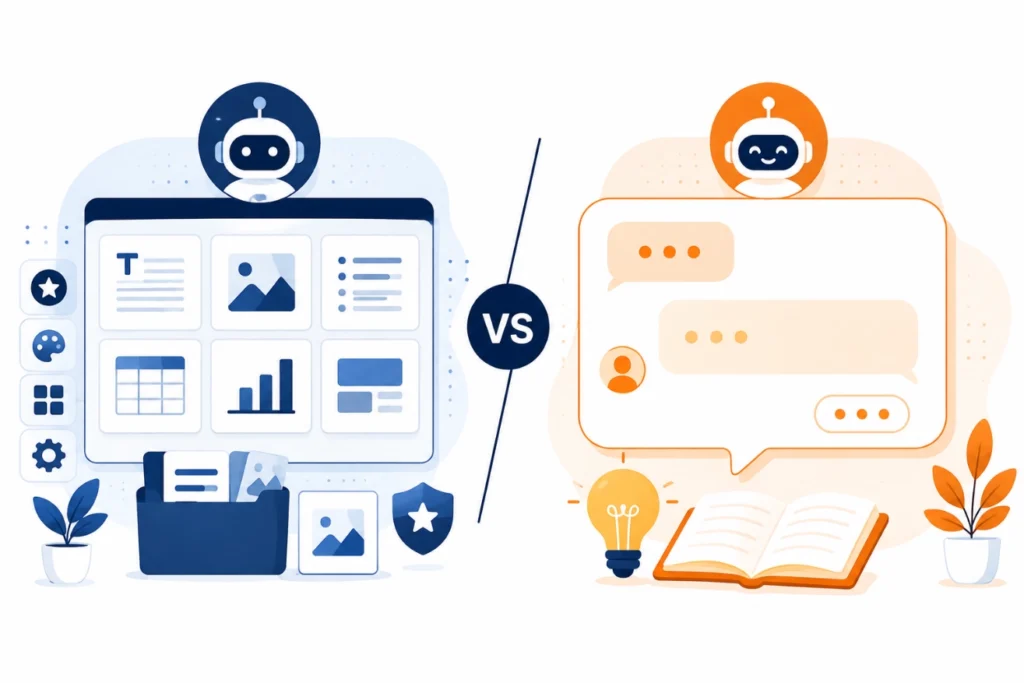
The comparison people actually want to know: is Jasper worth it over just using ChatGPT or Claude directly?
It depends on what you’re optimizing for. A general-purpose assistant is more flexible, cheaper, and better at open-ended thinking, research, or anything outside a marketing template. Jasper is narrower but faster for the specific, repeatable marketing tasks it’s built around, and it adds team infrastructure, like shared brand voice and permissions, that a standalone chatbot simply doesn’t have.
If you’re one person occasionally writing marketing copy, a general-purpose assistant will probably cover it for a fraction of the price. If you’re coordinating content across a team or multiple brands and need consistency without everyone reinventing their own prompts, that’s the situation Jasper is actually built for.
Who Should Use It (and Who Shouldn’t)

Worth it if:
- You’re producing marketing content on a regular, ongoing basis, not occasionally
- Multiple people write for the same brand and need to sound consistent
- You run repeatable campaigns (product launches, ad batches, email sequences) where a reusable workflow pays for itself
- You’re willing to invest setup time in Brand Voice, Knowledge assets, and templates rather than using it out of the box
Skip it if:
- You blog occasionally or write solo without a team to coordinate
- Your content needs are technical, deeply researched, or highly specialized
- You’re price-sensitive and mainly need occasional writing help
- You want flexible, open-ended brainstorming more than structured output
My Hands-On Experience with Jasper AI
I didn’t want to judge Jasper AI based only on its marketing pages, so I tried it with a few common marketing tasks to see how it performed in real-world scenarios.

Test 1: Product Description Writing
I gave Jasper a short list of product features and asked it to create a product description.
My observation: The output was well structured, persuasive, and consistent in tone. It followed a marketing style naturally, although I still needed to edit a few sentences to make them more specific and accurate. It was a strong starting point rather than something I would publish unchanged.
Test 2: Blog Post Draft
Next, I asked Jasper to generate an outline and draft for a blog article.
My observation: Jasper produced a logical structure quickly, but the content lacked depth in some sections. I had to add examples, recent information, and my own insights before it felt complete. For long-form content, I see Jasper as a drafting assistant rather than a replacement for research.
Test 3: Marketing Copy
I also generated several ad headlines and email subject lines.
My observation: This is where Jasper impressed me the most. It produced multiple variations in seconds, making it much easier to brainstorm campaigns without starting from scratch.
Overall Experience with Jasper Ai
After testing these workflows, my biggest takeaway is that Jasper performs best when you’re creating repeatable marketing content. It helps you work faster and maintain a consistent brand voice, but it still benefits from human editing before publication.
Frequently Asked Questions
Does Jasper AI have a free plan?
No. Jasper dropped its free tier and now offers only a 7-day free trial, which typically requires a credit card to start.
Is Jasper AI worth $69 a month?
For a team producing consistent, on-brand marketing content regularly, yes — the time saved on repeatable work tends to justify the cost. For occasional or solo writing, a cheaper or general-purpose tool is usually the better fit.
Can Jasper replace a content team?
No. It speeds up drafting and keeps output consistent, but strategy, research, editing, and final judgment calls still need a person. Treat it as leverage for a team, not a replacement for one.
What’s the difference between the Pro and Business plans?
Pro is built for a single user or very small team with a handful of Brand Voices and Knowledge assets. Business removes those caps, adds the AI Studio agent builder, API access, and admin controls, and is priced individually based on your organization’s needs.
Does Jasper do SEO?
It integrates with SEO tools rather than replacing them outright, and some of that functionality may require an additional subscription. It’s not a native, all-in-one SEO suite.
Is Jasper good for blog writing?
It’s decent for structure and speed, weaker on depth. It works best as a fast first draft you then research and expand, not as a finished article generator.

The Bottom Line
Jasper in 2026 isn’t the same tool it was even a year ago, it’s shifted from “writing assistant with templates” toward a genuine marketing workflow platform, agents included. That shift is real value if you’re running content at team scale and need consistency across writers and campaigns. It’s a much harder sell if you’re a solo creator or occasional blogger, where the price and the learning curve outweigh what you’d actually use.
Check Jasper’s current pricing page before committing either way plans and what’s included in each tier have moved more than once this year, and probably will again.