I’ve been paying for ChatGPT and Claude side by side for a long time now, and I’ve changed my mind about which one “wins” at least three times.
That’s not indecision. It’s that the question itself keeps shifting. Two years ago you could settle ChatGPT vs Claude by pointing at a benchmark chart and calling it a day. In 2026 that approach is close to useless, because both companies stopped shipping single flagship models. OpenAI runs a family – GPT-5.6 Sol, Terra and Luna, with GPT-6 Astra now arriving on paid tiers. Anthropic runs its own spread of Fable 5.1, Opus 5, Sonnet 5 and Haiku 4.5. The two labs don’t even report the same benchmarks anymore, which tells you how much the marketing has drifted from anything you can compare directly.
So I stopped asking which model is smarter and started asking a more useful question: which one gets more of my actual work finished in a week?
This article is my answer. I’ll walk through pricing, writing, coding, research, features, and the honest pros and cons of each. Not a spec sheet, and not a fake-neutral “it depends on your use case” cop-out. By the end you’ll know which subscription deserves your money, whether it’s worth running both, and where each one quietly wastes your time.
A quick note on trust: nobody paid me for this. I don’t have an affiliate deal with Anthropic or OpenAI. I’m just someone who uses both tools every working day and got tired of reading comparisons written by people who clearly only use one.
ChatGPT vs Claude: The Short Answer
If you want the verdict before the reasoning, here it is.
Claude is better for writing, long-document work, and sustained coding on real codebases. ChatGPT is better for breadth — images, voice, browsing, agents, and general everyday questions. If you can only pay for one and your work is mostly text and code, pick Claude. If your work touches a bit of everything, pick ChatGPT.
Here’s the same thing in a table, current as of September 2026:
| ChatGPT | Claude | |
|---|---|---|
| Entry paid plan | Plus, $20/month | Pro, $20/month ($17 billed annually) |
| Cheaper paid tier | Go, $8/month | None |
| Free tier | Unlimited text chats, ads in the US | No ads, tighter usage window |
| Flagship models | GPT-5.6 Sol, plus GPT-6 Astra rolling out | Opus 5, Fable 5.1, Sonnet 5 |
| Coding agent included at $20 | Codex | Claude Code |
| Image generation | Yes | No |
| Voice | Advanced voice, including video | Voice mode on mobile, text-first product |
| Heavy-use tiers | Pro at $100 or $200/month | Max at $100 or $200/month |
| Best at | Breadth, speed, multimodal | Writing quality, long context, agentic coding |
Now the part that actually helps you decide.
What You’re Actually Paying For in 2026
Most ChatGPT vs Claude comparisons skip this, and it’s the single biggest source of confusion I see from readers. When you subscribe, you aren’t buying “ChatGPT” or “Claude.” You’re buying access to a tier of a model family, and the tier matters more than the brand name on the box.
Inside ChatGPT
OpenAI’s GPT-5.6 family reached ChatGPT on July 9, 2026. It splits three ways. Sol is the flagship reasoning model and it starts at Plus. Terra and Luna sit below it, with Luna now serving as the everyday default on the Free and Go tiers since early August 2026. ChatGPT Pro subscribers get Sol Pro, a higher-effort variant of the same flagship.
Then there’s GPT-6 Astra, which OpenAI launched on September 3, 2026. It’s rolling out to Plus, Pro, Business and Enterprise, though availability still varies by account. If you open ChatGPT and don’t see it yet, that’s normal and not worth troubleshooting.
The practical takeaway: the $8 Go plan and the free plan run the same everyday model. Paying $8 buys you headroom on uploads, images and memory, not a smarter assistant.
Inside Claude
Anthropic’s current lineup is Opus 5 (the general flagship), Fable 5.1 (tuned harder for agentic coding, with extra safety measures), Sonnet 5 (the fast workhorse, with a 1M-token context window in chat) and Haiku 4.5 (the cheap, quick one). There’s also a Mythos tier above Opus that isn’t publicly available.
Claude Pro at $20 gets you all of these, with tighter caps on the heaviest models. Max at $100 or $200 buys capacity, not exclusive intelligence — which is a distinction worth remembering before you upgrade.
The honest summary: at the $20 tier, both companies now give you a genuinely frontier-class model. The raw intelligence gap that existed in 2023 and 2024 has mostly closed. Stanford’s 2026 AI Index put the top four labs within 25 Chatbot Arena Elo points of each other back in March. That’s a rounding error in day-to-day use.
Which means the decision comes down to everything around the model.
ChatGPT vs Claude Pricing: The Real Comparison
Both headline subscriptions cost $20 a month. That’s where the similarity ends.
ChatGPT Plus vs Claude Pro
ChatGPT Plus ($20/month) gets you GPT-5.6 Sol, advanced image generation, Sora video, the Codex coding agent, Agent Mode, expanded Deep Research, Projects, custom GPTs, Canvas, memory across chats, and voice. It is, by a wide margin, the more feature-dense $20 in the AI market.
Claude Pro ($20/month, or $200 up front for the year) gets you Opus 5 and the rest of the lineup, Claude Code, Claude Cowork, Projects, Artifacts, Research, connectors, and web search. Fewer boxes ticked. But two of those boxes are unusually valuable, and I’ll come back to them.
The annual option is worth a mention because ChatGPT doesn’t offer one for individuals. Claude Pro at $200 prepaid works out to about $17 a month. Small, but it’s $36 a year you don’t have to think about.
The Cheap Tiers, and the Ads Question
ChatGPT has a genuinely good free plan now. Since August 2026, free accounts get unlimited text conversations running on GPT-5.6 Luna, with a Think button for harder problems. Images, uploads and voice stay capped, and US free users see ads, which OpenAI rolled out on February 9, 2026.
Claude’s free tier has no ads at all. Anthropic has been explicit that it doesn’t run advertising in its products and doesn’t let anyone pay to be mentioned in a conversation. The trade-off is a stricter usage window — free Claude runs out faster than free ChatGPT.
Whether that matters is a personal call. For me it does. When a product’s revenue starts coming from advertisers rather than users, the incentives shift, and I’d rather not find out where that leads with a tool I ask personal and professional questions all day.
There’s also ChatGPT Go at $8/month. I’ve tried it and I don’t recommend it. It leaves out Deep Research and Agent Mode, runs the same default model as the free tier, and may still show ads depending on where you live. If $20 is too much, use the free tiers of both instead. You’ll learn more.
When the $100 and $200 Tiers Make Sense
Claude Max and ChatGPT Pro both run $100 for roughly 5x the standard capacity and $200 for roughly 20x.
My rule, learned the expensive way: don’t upgrade until you can name the exact bottleneck. If you can’t finish a sentence that starts “I upgraded because I kept hitting ___ on Tuesday afternoons,” you don’t need it. These tiers buy throughput, not better thinking. The people who genuinely need them are running coding agents for hours at a stretch or doing high-volume research, and they know exactly who they are.
One real exception on the ChatGPT side: the $200 Pro tier includes unlimited Sora video generation, which the $100 tier does not. If video is your business, that’s a concrete reason rather than a vanity purchase.
ChatGPT vs Claude for Writing: Where I Have a Clear Favorite
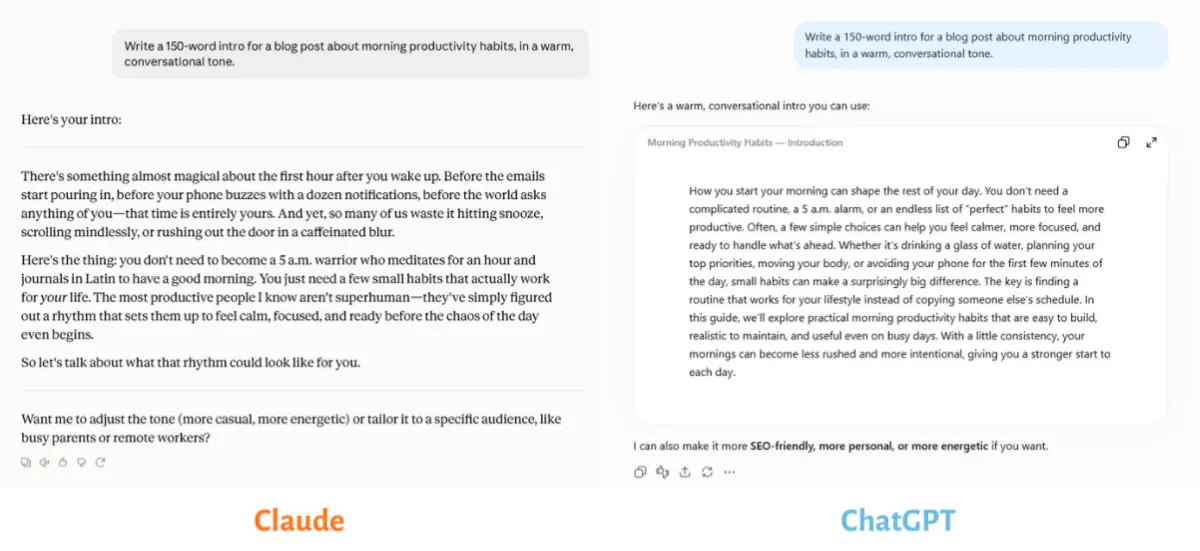
I write for a living, so this is the category I’ve tested most obsessively. My method is boring but fair: same brief, same background context, same word count target, both tools, then I measure how long editing takes.
Claude consistently needs less editing. Not because its first draft is brilliant, but because it makes fewer of the specific mistakes that are annoying to fix. It doesn’t reach for a bulleted list every time the topic gets slightly complex. It doesn’t open paragraphs with “In today’s rapidly evolving landscape.” It doesn’t stuff in hedging qualifiers that nobody says out loud. When I paste in 800 words of my own writing and ask it to continue, the continuation usually sounds like a slightly stiffer version of me rather than a press release.
Where ChatGPT Pulls Ahead on Writing
ChatGPT writes competently and fast. GPT-5.6 is a real improvement over what came before, and the gap has narrowed. But there’s still a texture to the output that I recognize instantly — a formatting instinct that wants headers and bullets and bolded lead-ins whether or not the content needs them. Editing that out takes me longer than editing prose that was never structured that way.
Where ChatGPT genuinely beats Claude on writing tasks: volume ideation. If I need thirty headline variations, thirty hooks, or thirty angles on a topic, ChatGPT throws them at the wall faster and with more range. Claude gives me twelve more considered ones. For brainstorming, quantity has real value, and ChatGPT wins there.
One tip that matters more than the tool choice: load your context properly. I keep a Claude Project with my style guide, three published pieces, and a short document describing what I never want it to do. First drafts came back noticeably closer to usable after that, and it took twenty minutes to set up. ChatGPT Projects and custom instructions do the same job.
[Internal link opportunity: link to your “how to write with AI without sounding like AI” or prompt-engineering guide here.]
ChatGPT vs Claude for Coding: Claude Code vs ChatGPT Codex
This is the most interesting category in 2026 because the answer genuinely splits.
What the Benchmarks Say
On SWE-bench Verified, which measures resolving real GitHub issues, Claude Opus 5 leads at 97.0% on the independent vals.ai leaderboard. That’s a large jump from the 88.6% its predecessor scored.
On Terminal-Bench 2.1, which measures agentic command-line work, GPT-5.6 Sol leads at 85.8% against Opus 5’s 84.6% on the same independent run.
On DeepSWE, Opus 5 resolves 74% of tasks — the top score — but costs about $11.84 per task against Sol’s $8.39.
Read those three numbers together and you get the actual picture: Claude is stronger at understanding and fixing code in a real repository. ChatGPT is stronger and cheaper at terminal-native agentic work. Anyone claiming a clean sweep for either side is picking the benchmark that supports their conclusion.
The old context-window argument is over, by the way. Both model families now read up to 1M tokens. If you read a comparison still claiming Claude has a decisive context advantage, it was written before mid-2026.
What It Feels Like Day to Day
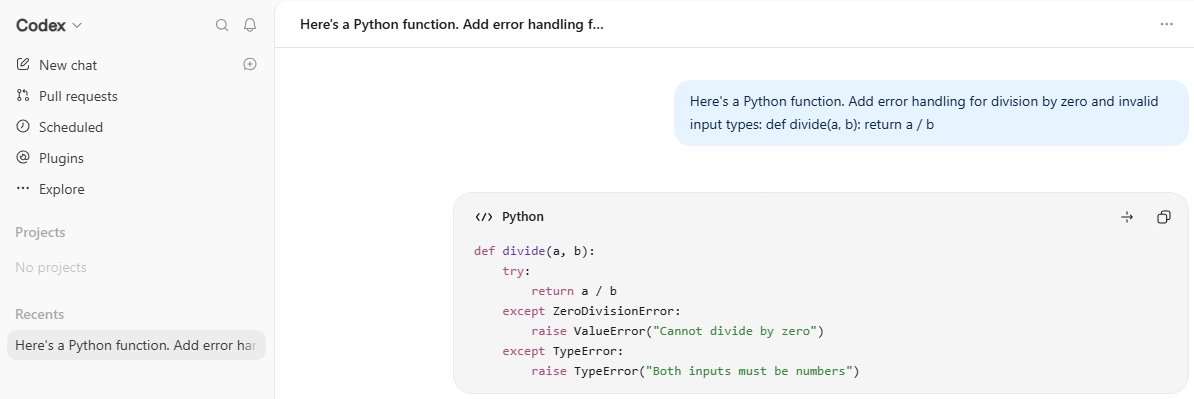
I’m not a professional engineer. I’m someone who ships side projects, which means I need code that works and explanations I can evaluate. Also you can read my “how to use chatgpt” beginners guide.
ChatGPT Codex is included with Plus at the same price. It spawns up to eight parallel subagents in isolated cloud sandboxes, has persistent memories across sessions, and can schedule future work and wake up to continue it. Its published limits on Plus run looser than Claude Pro’s, which is a real advantage in the middle of a long session.

Claude Code is included with Pro at $20. It’s a terminal agent that reads your whole codebase, plans an approach, edits across multiple files, and runs your tests. Its Agent Teams feature runs multiple agents that share a task list and message each other. The adoption numbers are genuinely striking — Claude Code now authors something on the order of 326,000 GitHub commits a day, roughly 10% of all public commits.
My split, honestly stated: Claude Code for messy interdependent work in a repo I care about. Codex for scripts, DevOps, CLI tooling, and anything where I want parallel work happening in the cloud. The rate limits are the deciding factor more often than quality. I’ve switched to Codex mid-task purely because Claude told me to come back later, and that’s a real cost.
[Internal link opportunity: link to your Claude Code setup tutorial or “best AI coding tools” roundup.]
ChatGPT vs Claude for Research: A Genuine Split
Research is really two different jobs, and each tool owns one.
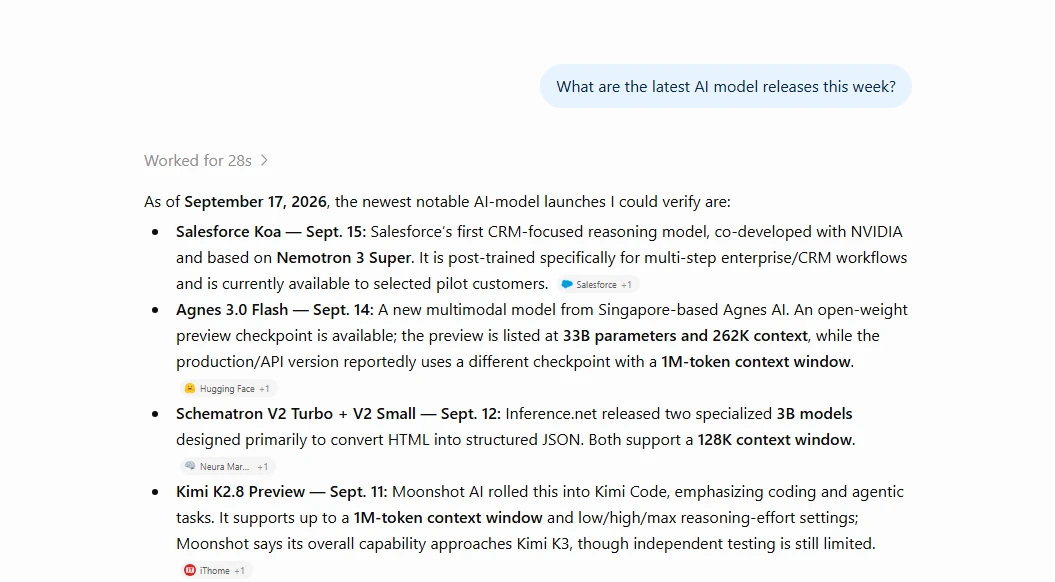
Finding information goes to ChatGPT. Browsing has been deeply integrated for years, Deep Research produces long sourced reports, and Agent Mode can actually go do multi-step tasks on the web. For “what changed this week” or “what does this product cost now,” it’s fast and reliable.
Understanding information you already have goes to Claude. Hand it a 200-page PDF, a contract, a dense research paper, or a folder of documents, and the quality of reasoning across that material is the clearest capability gap I can still point to. Claude Cowork, which became generally available in April 2026 and comes with all paid plans, takes this further — it reads and edits files in a folder on your machine and runs multi-step work in the background while you do something else.
And here’s the thing I’d tell a friend: for pure search-based research, use neither as your only tool. Perplexity was purpose-built for it and shows it. ChatGPT and Claude are reasoning engines with search attached. Perplexity is a search engine with reasoning attached. Different machines.
ChatGPT vs Claude Features: The Breadth Gap
If you make a feature checklist, ChatGPT wins and it isn’t close.

ChatGPT has that Claude doesn’t: image generation, Sora video, advanced voice mode including video, custom GPTs, ChatGPT Sites, and a much larger third-party app ecosystem.
Claude has that ChatGPT doesn’t, or does differently: Claude Code as a terminal-native agent, Cowork for local file work, Artifacts that render live and can be published as shareable pages, Claude in Chrome as a browser side panel, and tools that work directly inside Excel and PowerPoint.
Claude does have voice mode, including free on mobile, so the “Claude has no voice” line you’ll read in older articles is outdated. But it’s text-first by design and ChatGPT’s voice is more capable and more multimodal.
The image generation gap is the one that actually interrupts my workflow. Claude cannot generate images. Not a single pixel. When I need a header graphic mid-draft, I have to leave and go somewhere else. If visuals are part of your daily output, that’s a genuine reason to keep ChatGPT regardless of everything else in this article.
ChatGPT vs Claude: Pros and Cons
Pros of ChatGPT : the broadest feature set at $20, image and video generation built in, excellent voice, mature browsing and Deep Research, looser rate limits on Plus, genuinely generous free tier, faster on simple questions.
Cons of ChatGPT: seven plans is too many and I have to explain them every time someone asks; ads on free and Go tiers in the US; writing still has a recognizable machine texture; some features feel shipped rather than finished; the $100 to $200 jump is hard to justify for most people.
Claude pros: better writing out of the box, excellent long-document reasoning, Claude Code included at $20, Cowork for background file work, cleaner plan structure, no ads anywhere, more willing to say “I’m not sure” than to invent an answer.
Claude cons: rate limits bite in the middle of a session and it’s genuinely disruptive; no image generation; occasionally cautious about requests that are completely reasonable; slower on quick questions; fewer third-party integrations.
How I Actually Split My Week
Concrete beats abstract, so here’s the real pattern.
Claude gets: first drafts of anything I’m going to publish, contract and document review, any coding session on an existing project, and background file work through Cowork while I’m doing something else.
ChatGPT gets: blog graphics, quick factual lookups where I want a source, voice sessions while I’m driving or cooking, brainstorming when I want volume, and coding overflow whenever Claude tells me to wait.
Neither gets: deep research that needs to be exhaustive. That goes to Perplexity.
Total spend on the two: $40 a month. Whether that’s worth it for you depends entirely on whether your work genuinely spans both columns. If 90% of what you do is writing and code, one subscription is enough and the second is a waste.
Frequently Asked Questions
Is Claude better than ChatGPT?
For writing quality, long-document analysis, and sustained coding in a real repository, yes. For image generation, voice, browsing, and general breadth, no. If you’re a writer, developer, analyst or researcher, Claude is the better $20. If you want one assistant that handles a bit of everything, ChatGPT covers more ground. Neither is better across the board in 2026.
GPT-5.6 vs Claude: which model is actually stronger?
Most people asking Claude vs ChatGPT at the model level expect one clear winner, and there isn’t one. They trade wins. Claude Opus 5 leads SWE-bench Verified at 97.0% on independent testing, while GPT-5.6 Sol leads Terminal-Bench 2.1 at 85.8%. Both families read up to 1M tokens of context. At the level most people work at, the difference you’ll feel comes from the tools wrapped around the model rather than the model itself.
Should I pay for both ChatGPT and Claude?
Only if your work genuinely spans both strength profiles. At $40 a month combined it’s excellent value if you’re using both weekly. If you’re opening one of them twice a month, cancel it. A useful test: go one full week using only the cheaper option and see what you actually missed.
Is ChatGPT Go at $8/month worth it?
Not in my view. Go runs the same default model as the free tier, skips Deep Research and Agent Mode, and may still include ads. What you’re buying is headroom on uploads, images and memory. If $20 is out of reach, run the free tiers of both ChatGPT and Claude and switch when you hit a wall.
Which one hallucinates less?
In my experience Claude is more likely to flag uncertainty than to confidently fill a gap, and that matches what I see reported across developer communities. ChatGPT has improved a lot but still tends to present shaky information with unearned confidence. Either way: verify every statistic, citation, date and technical claim before you publish it. Both tools will let you down eventually.
The Bottom Line
Whether you searched for ChatGPT vs Claude or Claude vs ChatGPT, the honest 2026 answer isn’t about which model scores higher on a leaderboard. Both are frontier-class at $20. The real question is which product’s philosophy matches how you work.
OpenAI is building the everything-platform: one app that talks, sees, browses, generates, and acts. Anthropic is building the thinking partner: fewer features, executed further. Both are legitimate bets, and the one that fits you depends on whether you want maximum surface area or maximum depth.
My recommendation, stated plainly: start with the free tiers of both this week. Run your real work through each. You’ll know within five days which one you keep reaching for, and that instinct is more reliable than any comparison table, including mine. If you’re a writer or developer and you want the short version, start with Claude Pro. If your work touches images, voice, or constant browsing, start with ChatGPT Plus.
Then come back and tell me I got it wrong. I’ve changed my mind three times already, and I’d genuinely like to hear what your testing showed.
Prices, model names and benchmark figures in this article were verified in September 2026. This space moves fast, so check the official pricing pages before you buy. I have no affiliate relationship with Anthropic or OpenAI and was not compensated by either company.