Is DeepSeek Safe? What the Sources Show as of November 2026
DeepSeek is reasonably safe for everyday questions you wouldn’t mind a stranger reading, and a poor choice for anything personal, confidential or regulated. Its own privacy policy says your data is stored in China and used to train its models, and it tells you not to give it sensitive personal information.
This guide is for anyone deciding whether to use DeepSeek for real work: what its documents say, what I found in the app’s settings, what governments have done, and what independent testing found. Sources were checked on November 16–17, 2026.
ToolsWorldAI doesn’t sell VPNs or security software, and there are no affiliate links on this page.
Quick answer: is DeepSeek safe to use?
It depends on what you put into it. Here is my call for common situations, based on the sources below. It’s editorial judgment, not legal or security advice.
| Your situation | My call | Why |
|---|---|---|
| Casual questions with nothing personal in them | Fine, with the trade-offs understood | Inputs are stored in China and used for training unless you switch that off. |
| Personal matters (health, money, relationships) | Avoid | DeepSeek’s policy says its services aren’t designed for sensitive personal data. |
| Client, employer or confidential business data | Avoid unless your company has approved it | No fixed retention period; data held under Chinese law. |
| Regulated data (patient, financial, legal records) | Avoid | Same reasons, plus your own compliance duties. |
| Developers building agents on DeepSeek models | Be careful | NIST found older DeepSeek models far easier to jailbreak and hijack. |
| Running DeepSeek’s open models on your own computer | Generally lower privacy risk | Prompts stay on your machine if you keep the server local. |
| US federal agencies and their contractors | Not allowed on federal systems | A 2026 DHS order removes DeepSeek from federal civilian systems. |
What “safe” means here
People asking this usually mean one of three things, and the evidence differs for each.
Privacy is about what happens to what you type: where it’s stored, who can see it and how long it’s kept. Model security is about how easily the model can be tricked into harmful behavior, which matters most if you build tools on it. Legal status is about whether governments allow it, and for whom.
DeepSeek’s documented weak spots are privacy and model security. Its legal status depends on who you are.
What DeepSeek’s privacy policy says
I read DeepSeek’s privacy policy (last updated February 10, 2026) and Terms of Use (last updated March 27, 2026) in full. The company behind the service is Hangzhou DeepSeek Artificial Intelligence Co., Ltd., registered in China.
What it collects
According to the policy, DeepSeek collects your account details and everything you put in: text, voice, uploaded files, photos and chat history. It also collects device and network data, such as your IP address, device IDs and operating system, plus usage logs and an approximate location based on your IP.
The policy says it doesn’t extract voiceprints or facial recognition data from voice or photo inputs.
Where your data goes and who sees it
The policy says DeepSeek collects, processes and stores your personal data “in People’s Republic of China.” The Terms are governed by the law of mainland China.
It shares data with service providers, including a third-party search service that receives the keywords from your input, and with companies in its corporate group. It also shares data with law enforcement or public authorities when it believes in good faith that disclosure is necessary. The policy says it doesn’t sell your data or use it for targeted advertising.
That legal setting is one of the US government’s main concerns. In its 2026 order, the Department of Homeland Security pointed to Chinese law that could compel disclosure, according to the Congressional Research Service. Whether that law has been used to obtain any DeepSeek user’s data isn’t public, and I found no evidence that it has. The risk is exposure, not proven abuse.
Training, retention and deletion
DeepSeek uses your inputs to train and improve its models. Its Terms say you can opt out by turning off a setting called “Improve the model for everyone.”
Some blogs say DeepSeek has no training opt-out. That’s not what its own documents say, and the setting is in the app. On November 16, 2026, I opened Settings in DeepSeek’s web chat on my free account (signed in with Google). Under Data, the “Improve the model for everyone” switch was turned on, with the description “Allow your content to be used to train our models and improve our services.” I had never touched it, so it was on by default for my account.
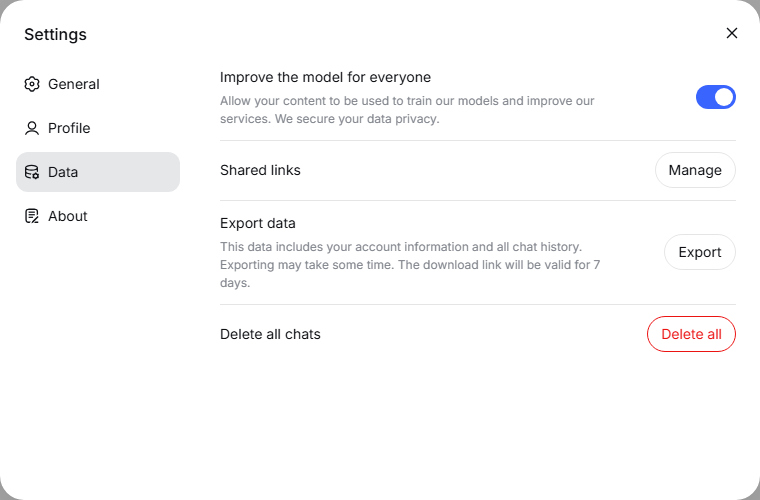
The same Data tab has buttons to manage shared links, export your data (account information and all chat history, through a download link valid for seven days) and delete all chats. Under Profile there’s a Delete account button, plus options to manage devices and log out of all devices. I didn’t press Delete, so I can’t confirm what happens afterward.
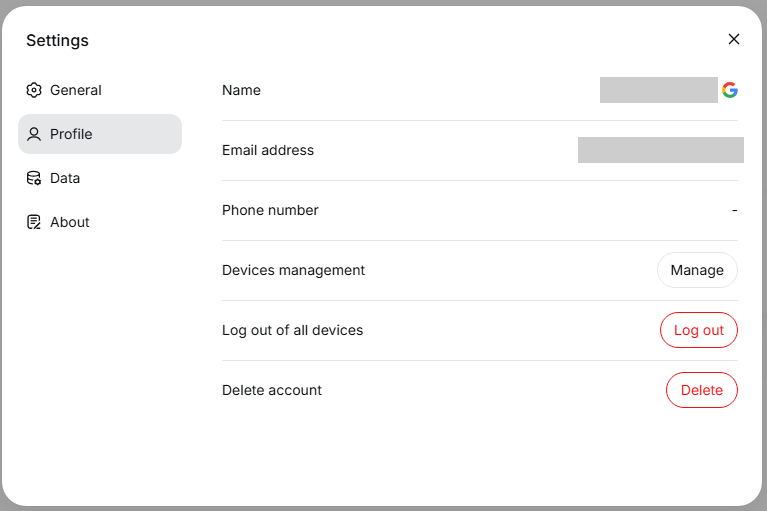
Two limits apply. A switch in the settings can’t show what happens on DeepSeek’s servers; only the company knows that. And the privacy policy says the right to opt out of training applies “depending on where you live.” I checked from outside the US, so the switch may look different, or be missing, in other countries.
On retention, the policy gives no fixed period. It keeps data “as long as necessary,” and it keeps account, input and payment data for as long as your account exists. It says deleting an account can’t be undone.
DeepSeek’s own advice: don’t share sensitive data
The plainest rule comes from DeepSeek itself. Its policy says its services aren’t designed to process sensitive personal data, such as health, biometric or precise location data, and asks you not to provide it. Take that literally.
Shared links and apps built on DeepSeek
If you publish a chat link, the policy warns that third parties may crawl it. You can review your links under Settings > Data > Shared links.
Apps and websites built by other companies on DeepSeek’s platform are not covered by this policy. The developer who built the app decides how your data is handled.
What the app stores and asks for
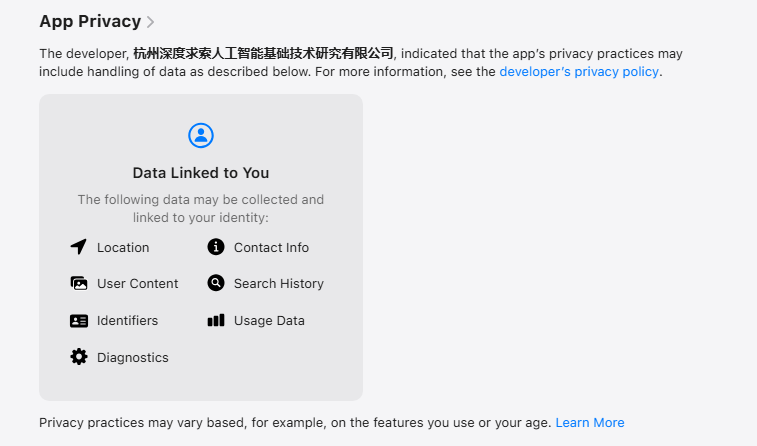
Privacy labels on app stores are declarations by the developer, not audits, but they show what DeepSeek tells Apple and Google it collects. I checked both listings on November 16, 2026. The labels describe the app in general, not a specific version.
On Apple’s App Store, the developer is listed under its Chinese company name. Its “Data Linked to You” section lists Location, Contact Info, User Content, Search History, Identifiers, Usage Data and Diagnostics. Apple defines this as data that may be collected and linked to your identity.
On Google Play, the “Data safety” section says the app may share device or other IDs with third parties, and may collect location, personal info and five other data types. It says data is encrypted in transit and that you can request deletion.
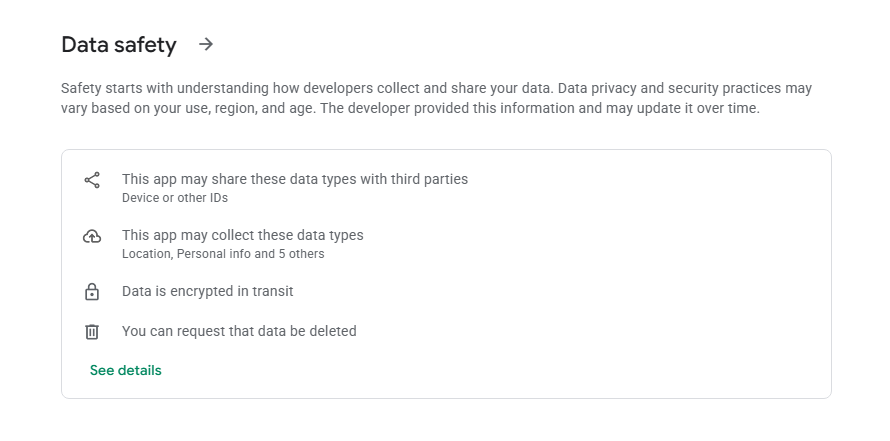
Apple’s label lines up closely with the privacy policy. Google’s summary is less specific, but it also names location and personal info.
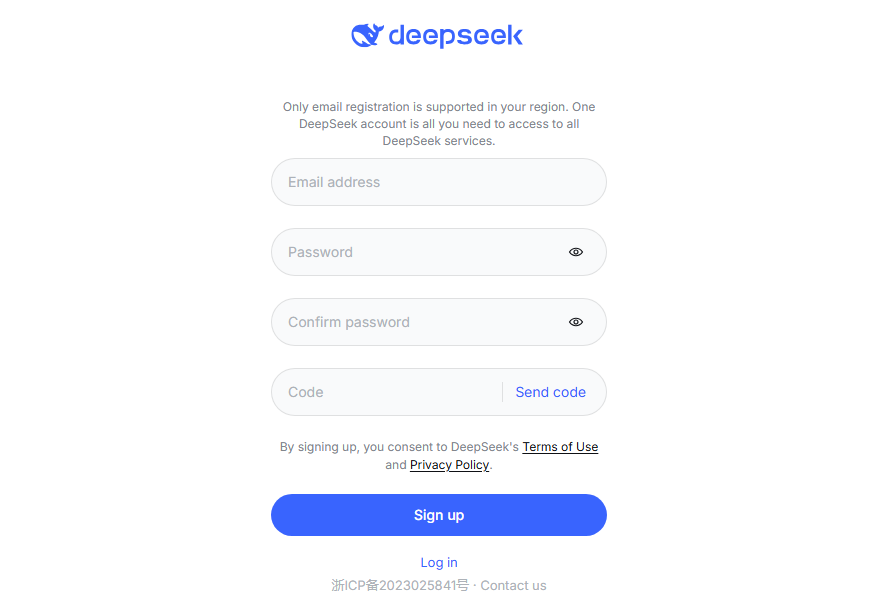
Signing up requires an email address or a Google or Apple account. The log-in page also accepts a phone number, but the sign-up page told me “Only email registration is supported in your region.” Both pages say that signing up or logging in means you consent to the Terms of Use and Privacy Policy. I saw no separate consent screen or checkbox. I checked from outside the US, so sign-up options in the US may differ.
What governments have actually done
United States: federal orders in 2026
On October 20, 2026, DHS published a notice in the Federal Register of an order that bars DeepSeek products from federal civilian agency purchasing. The order also removes DeepSeek products, and third-party products built using DeepSeek, from those agencies’ systems. It was issued under the Federal Acquisition Supply Chain Security Act.
According to the Congressional Research Service, the order is dated July 24, 2026, extends to federal contractors, and lets agencies ask CISA for exceptions. It’s the first time DHS has used this authority. The Defense Department issued its own order on September 8, 2026, as required by the 2026 defense authorization act, and the Director of National Intelligence issued a similar one.
DHS’s stated concerns, as summarized by the CRS, are Chinese law that could compel disclosure, the personal information needed to create an account, sensitive information in what people type and receive, and insecure app configuration. China’s Foreign Ministry objected to the move, TechCrunch reported.
The order applies to government systems. The CRS states that it doesn’t restrict private use. If you’re not a federal employee or contractor, DeepSeek isn’t banned for you in the US.
For context on how other AI rules are developing, see our roundup of US AI regulation news.
Other governments in 2025
Several governments restricted DeepSeek on official systems in 2025. These are the ones I could confirm at an official source:
| Date (2025) | Government or body | What it did | Source |
|---|---|---|---|
| January 31 | Taiwan’s Ministry of Digital Affairs | Classified DeepSeek as a national cybersecurity risk and told government agencies and critical-infrastructure operators to restrict its use | Ministry of Digital Affairs |
| February | Australia’s Department of Home Affairs | Issued a direction finding DeepSeek an “unacceptable level of security risk” for federal government systems; states such as Victoria followed | Victorian Government guideline |
| July 10 | Czech cybersecurity agency (NÚKIB) | Rated DeepSeek products, including its API, a “High” threat for critical and regulated systems | NÚKIB warning |
Italy’s data protection authority and the state of Texas also acted in early 2025, according to press reports at the time. I couldn’t reach their official pages, so I haven’t included the details.
What the bans don’t tell you
Government bans reflect the risk to government data and systems. They aren’t evidence that ordinary users’ data has been misused. They do tell you that several security agencies judged the exposure too high for their own staff, which is worth weighing if you handle work data.
The Czech agency went a step further than most. It advised the public to “carefully assess” using DeepSeek and to think about what information they put into it, and it recommended that people in senior political or public roles avoid it entirely. Both the Czech warning and Victoria’s guideline exclude open-source DeepSeek models run locally without a connection to DeepSeek.
What independent testing found about the models
In September 2025, NIST’s Center for AI Standards and Innovation (CAISI) evaluated three DeepSeek models, R1, R1-0528 and V3.1, against four US models. Three findings matter for safety:
- Jailbreaking: with a common jailbreak technique, R1-0528 answered 94% of overtly malicious requests, compared with 8% for the US reference models.
- Agent hijacking: agents built on R1-0528 were, on average, 12 times more likely to follow malicious instructions planted to derail them. In a simulated environment, hijacked agents sent phishing emails, ran malware and leaked login credentials.
- Political narratives: the DeepSeek models echoed four times as many inaccurate and misleading Chinese Communist Party narratives as the US models.
Keep two things in mind. These were 2025 model versions, and newer ones may behave differently. And the evaluation was carried out under the US government’s AI Action Plan, and NIST’s announcement presents it as part of advancing American leadership in AI. The numbers come from a government lab’s tests; the framing is policy.
For casual chat, the jailbreak findings mostly mean the model’s guardrails are weaker. For developers who give a model access to email, files or a browser, the hijacking result is the serious one.
App, API, third-party host or local: what changes?
How you use DeepSeek changes who holds your data.
| How you use it | Where your prompts go | Main risk | Best for |
|---|---|---|---|
| DeepSeek app or website | DeepSeek’s servers in China | Everything in the privacy policy above | Non-sensitive everyday questions |
| DeepSeek API | DeepSeek’s servers | Same privacy policy and Chinese law; the API terms don’t say whether inputs are used for training | Developers building on non-sensitive data |
| A third-party app or host using DeepSeek models | That company’s servers | Depends entirely on that company’s policy | Only if you trust and have read that host’s policy |
| Open models on your own computer | Your computer | Exposing the local server to your network | Privacy-sensitive experiments, if your hardware can run them |
If you use the API, DeepSeek’s Open Platform Terms of Service (effective April 29, 2026) say the personal information you provide is handled under the same privacy policy, and that the terms are governed by Chinese law. You keep your rights in your inputs, and DeepSeek assigns you its rights in the outputs. The terms I read don’t directly address whether API inputs are used to train DeepSeek’s models. If your app serves other people, you’re responsible for telling them how their data is handled.
Running a DeepSeek model locally with a tool like Ollama keeps your prompts off DeepSeek’s servers. Ollama’s documentation says it listens only on your own machine (127.0.0.1, port 11434) by default, and that it doesn’t see your prompts when you run models locally.
Two cautions. If you change the OLLAMA_HOST setting to make the server reachable from other devices, you widen who can reach it. And Ollama’s “cloud” models are processed on Ollama’s servers, so they aren’t local.
Developers comparing options may also want our look at the coding tools we tested.
How I checked this
This article is mostly research-based. On November 16, 2026, I read DeepSeek’s privacy policy and Terms of Use, NIST’s CAISI evaluation, the Federal Register notice of the DHS order, and the Congressional Research Service’s summary of the federal orders. I also read Ollama’s documentation on local use. On November 17, I read DeepSeek’s Open Platform (API) terms and the official pages for the Taiwanese, Australian (via Victoria) and Czech actions.
My hands-on checks were limited to what any user can see. On November 16, 2026, I opened the settings in DeepSeek’s web chat on my own free account, and screenshotted the App Store and Google Play privacy labels and the sign-in and sign-up pages. I didn’t delete an account, test whether the training switch works behind the scenes, or analyze the app’s network traffic.
Separately, in October 2026 we ran the same six tasks on the free DeepSeek app alongside seven other assistants. That test is about usefulness, not safety.
What I didn’t cover: the official pages for the Italian and Texas actions (I couldn’t reach them), the signed DHS order itself (published only as images), and a side-by-side comparison with ChatGPT, Claude or Gemini privacy policies.
Our testing and editorial policy explains how we separate hands-on tests from research and how to report an error.
How to use DeepSeek with less risk
If you decide to use DeepSeek’s app or website, these steps lower the risk:
- Don’t paste anything you’d regret seeing in a leak: client data, passwords, health or financial details, or unreleased work. DeepSeek’s own policy asks you not to share sensitive personal data.
- Turn off the training switch under Settings > Data > “Improve the model for everyone” if you don’t want your chats used for training.
- Delete chats you don’t need using Settings > Data > Delete all chats.
- Keep shared links private, and review them under Settings > Data > Shared links.
- Consider a separate email address for your account rather than your work one.
- For sensitive experiments, run an open model locally, and keep the server bound to your own machine.
- If you manage a team, decide on a policy before staff start using it. Federal contractors are covered by the DHS order.
Small businesses choosing tools for a team can compare options in our guide to AI tools for small teams.
Who should avoid DeepSeek’s hosted service
Federal employees and contractors can’t use it on government systems. Anyone handling patient, financial, legal or client data should keep that data out of it, and anyone whose employer hasn’t approved it should ask first. If your compliance team needs specific contractual terms for an AI vendor, check whether DeepSeek offers them before you start, not after.
If you want an alternative with different trade-offs, see other AI chatbots compared, our ChatGPT Plus review and our Claude review. Whichever hosted chatbot you pick, read its privacy policy before you share work data.
FAQ
Does DeepSeek send my data to China?
Yes. DeepSeek’s privacy policy says it collects, processes and stores personal data in the People’s Republic of China, and its Terms are governed by Chinese law. That applies to the official app and website, not to models you run on your own computer.
Is DeepSeek banned in the US?
Not for private use. A DHS order published October 20, 2026 removes DeepSeek from federal civilian agency systems and contractors, and the Defense Department and intelligence community issued similar orders. The CRS says these orders don’t restrict private use. Contractors should check how they apply to their federal work.
Can I stop DeepSeek from training on my chats?
Yes, according to its Terms, by turning off “Improve the model for everyone.” The switch was under Settings > Data in my web account and was on by default. DeepSeek’s policy says this right can depend on where you live.
Is it safe to run DeepSeek locally?
Running an open DeepSeek model locally keeps your prompts on your machine, which removes the main privacy concern. Ollama listens only on your own computer by default. Don’t expose it to your network, and remember that Ollama’s cloud models aren’t local.
Is DeepSeek safe for work or client data?
I wouldn’t use the hosted service for it. DeepSeek keeps data with no fixed retention period, stores it in China, and its own policy says not to give it sensitive personal data. Check your employer’s policy first, and if you do use it, keep what you type generic.
How do I delete my DeepSeek data?
In the web app, open Settings. Under Data, “Delete all chats” is the option for clearing your chat history; under Profile, “Delete account” closes the account, which DeepSeek’s policy says can’t be undone. You can export your data first under Data > Export.
Bottom line
For quick, non-sensitive questions, DeepSeek is usable if you accept that your inputs are stored in China and, unless you switch it off, used for training. For personal, client or regulated data, use something else or run an open model locally. If you build AI agents, take NIST’s hijacking findings seriously.
Policies change. Before relying on this, check DeepSeek’s current privacy policy and settings. This article reflects what the sources showed on November 16–17, 2026.